Jailbreak and Root Detection Bypass Techniques
Server-side checks and layered defenses matter more than perfect detection in rooted environments.

An app cannot fully trust checks that run in an environment an attacker controls. For developers and penetration testers, the goal is therefore not an unbreakable detector. It is a layered defense that makes bypass harder, leaves transaction decisions with the server, and proves its value against actual attack tools.
What jailbreak and root detection actually does — and what it cannot do
Jailbreaking and rooting weaken the operating system protections an app depends on. On iOS, jailbreaking removes Apple’s sandboxing, code-signing enforcement, and file system protections, undermining assumptions behind authentication, encryption, and data isolation. On Android, rooting grants superuser access that can support binary extraction, runtime function hooks, access to SharedPreferences data, and changes to transaction logic. Detection looks for evidence that the environment has changed.
OWASP’s Mobile Application Security Verification Standard places this capability in MASVS-RESILIENCE and scopes it to high-risk app classes. Payment standards can impose more specific obligations. PCI CPoC and PIN CVM requirements call for device integrity checks in certain payment apps, while HIPAA safeguards extend to mobile devices handling protected health information and the FFIEC has published mobile banking guidance. These obligations place detection within an arms race in which defenders identify signs of compromise and attackers learn to conceal them.
How iOS and Android detection signals work before any bypass is attempted
File and directory checks look for paths specific to jailbreaks, while symbolic link checks look for another kind of file system artifact. DYLD library checks look for loaded libraries that point to changes in the environment. URL scheme probes test whether Cydia or other jailbreak apps respond.
The fork() check tests behavior. On a non-jailbroken device, a sandboxed app cannot spawn child processes, so the call fails. On a jailbroken device, it succeeds. iOS Security Suite, commonly shortened to ISS, bundles detection checks behind its amIJailbroken() method. An app that uses that method gets one result from several tests.
Android checks also look for a wide range of artifacts. Known paths include Superuser.apk and /system/xbin/su, with separate checks for the SU binary, BusyBox, and root management apps such as Magisk Manager and SuperSU. System property inspection examines ro.build.tags, ro.build.type, and ro.debuggable, with values such as test-keys or eng indicating a non-stock build. Other checks compare critical system file checksums with known values or attempt writes to protected locations such as /system and /data.
Google retired SafetyNet at the start of 2025 and replaced it with the Play Integrity API. Its device labels include MEETS_BASIC_INTEGRITY, MEETS_DEVICE_INTEGRITY, MEETS_STRONG_INTEGRITY, and MEETS_VIRTUAL_INTEGRITY for emulators, among other verdict categories. SafetyNet instead used the primary ctsProfileMatch and basicIntegrity pair, with an evaluationType field added in 2020. Flutter changes the integration layer. The flutter_jailbreak_detection plugin wraps RootBeer on Android and IOSSecuritySuite on iOS, so its checks run in native code.
The bypass hierarchy — from automated one-command tools to kernel-level hiding
OWASP’s Mobile Application Security Testing Guide documents Objection as a starting point for bypassing common jailbreak checks. Its automated jailbreak-disable function can neutralize common, unobfuscated detection libraries without manual reverse engineering. Objection uses Frida and is built to assess apps without requiring a rooted or jailbroken device. That makes it accessible in standard penetration testing environments. Hardened or obfuscated implementations can defeat this shortcut, pushing the tester toward targeted hooks.
Targeted Frida hooks replace a broad preset with control over a specific result. The guide’s example using a vulnerable training app locates -[JailbreakDetectionVC isJailbroken] through a symbol search and changes its return value from 0x1 to 0x0 in an onLeave callback. The check runs, but its answer changes. ISS presents a similar target when its method names remain visible, because a hook can make amIJailbroken() return false. Flutter apps that use the plugin have the same native checks, so a tester can use this approach without changing the binary.
When detection is inlined or buried in native code, hooks can move beneath the final verdict. Targets include open, access, stat, fork, dlopen, and NSFileManager’s file-existence method. A file check can receive a false absence result, while a library or process-behavior check can receive a substituted answer. The attacker no longer needs to find one clearly named jailbreak method.
iOS also supports runtime replacement through method swizzling and injected tweaks. Swizzling substitutes a detection method’s implementation with one that returns “not jailbroken,” provided the method can be found. Liberty Lite, A-Bypass, Shadow, and Hestia intercept calls through Cydia Substrate or Substitute before detection code executes. The mechanism differs from a standalone Frida script.
Blocked hooks create another step in the hierarchy. On Android, static patching can use apktool to expose Smali code and remove or neutralize root detection logic, followed by repackaging and re-signing. On hardened iOS apps, LLDB gives testers a way in without running Frida inside the process. Because of Address Space Layout Randomization, a tester must work out the runtime address of the return instruction they want to change before overwriting a register value. Both approaches take more work, but bypass is still possible.
Projects such as KernelSU can hook system calls or task-iteration logic to hide processes, files, and mounts at the kernel level. Instead of altering what one detection method returns, this approach changes what the operating system exposes to checks above it. File and process queries can then report a clean view because the layer supplying that view has been changed.
How the Android root-hiding stack defeats Play Integrity verdicts — and where it hits a hard limit
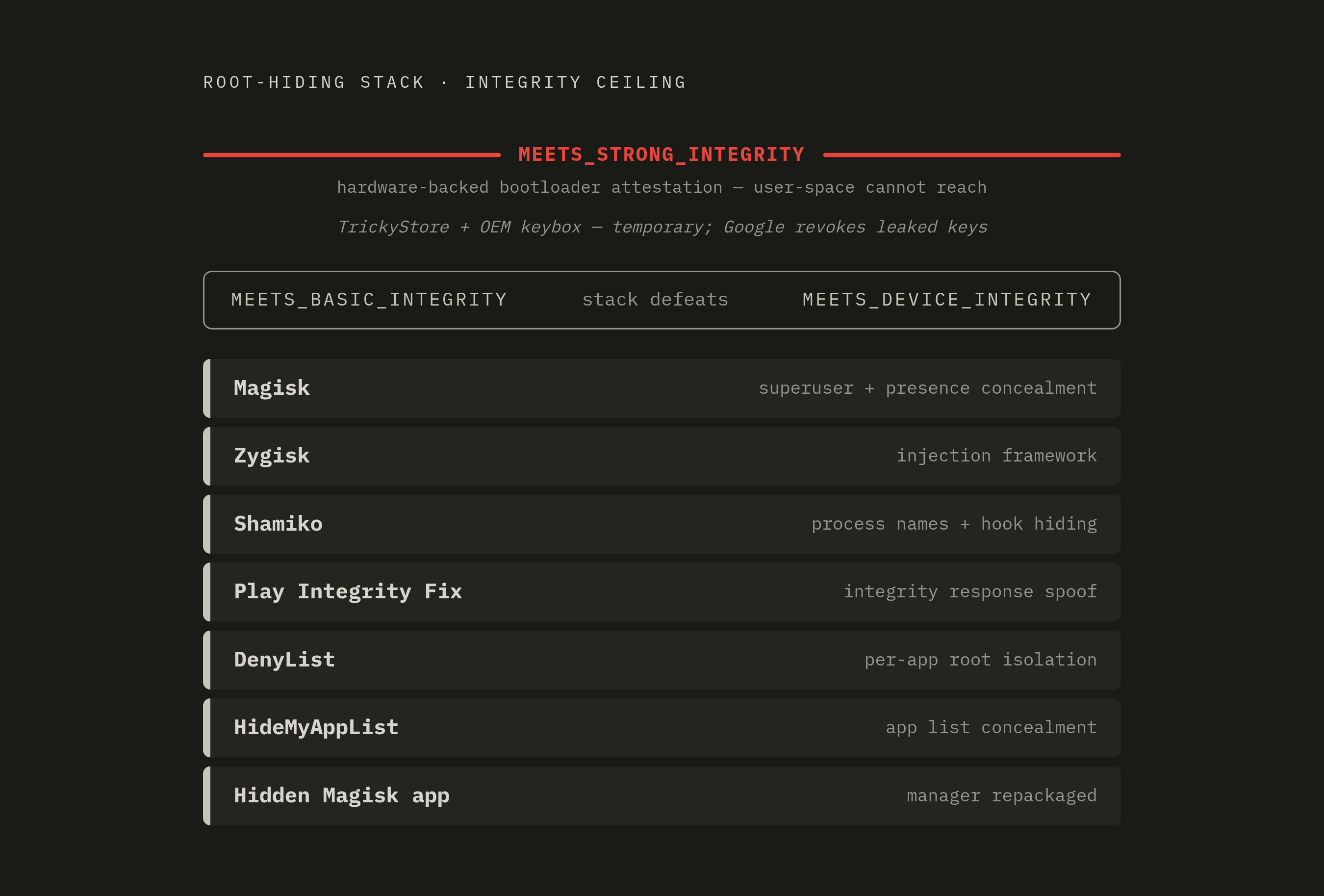
The Android hiding stack combines Magisk, enabled Zygisk, Play Integrity Fix, Shamiko, a DenyList configured for target apps, HideMyAppList, and a hidden Magisk app. These components address different signs of root. Magisk supplies superuser access while attempting to conceal its presence from listed apps. Shamiko, developed by the LSPosed team, hides Magisk process names and Zygisk hooks. Play Integrity Fix targets the integrity response so that the device can obtain MEETS_DEVICE_INTEGRITY.
This combination can defeat MEETS_BASIC_INTEGRITY and MEETS_DEVICE_INTEGRITY. The latter is the tier most banking apps require, which leaves their detection exposed to this configuration. Google Pay NFC payments also require MEETS_DEVICE_INTEGRITY. A device-integrity pass therefore has a specific limit. It is not proof that the hiding techniques described above are absent.
MEETS_STRONG_INTEGRITY introduces a different constraint through hardware-backed bootloader attestation. It gives defenders a genuine advantage by preventing a device with an unlocked bootloader from stably passing through the current user-space stack. TrickyStore with an unrevoked OEM keybox can temporarily spoof a pass, but Google revokes leaked keyboxes, making that route transient and unreliable. Some crypto wallet apps and the most sensitive banking operations may require this tier.
The distinction is between a repeatable bypass and a temporary exception. Strong integrity creates an architectural limit that ordinary app-level hiding does not remove. Its value would be overstated by calling every pass impossible to spoof. Its value would also be understated by treating it as just another file check that a hook can answer falsely.
Why layering more client-side signals does not solve the fundamental problem
Detection code and bypass code operate in an environment the attacker controls. More checks create more work for the attacker. They do not give the app an independent source of truth when hooks, patches, or kernel changes can alter the evidence it receives. OWASP MASTG explicitly describes root detection as inherently bypassable through hooking, patching, and concealment of root artifacts.
Obfuscation may force a tester past Objection, and native checks may force hooks down to lower-level functions. Those are useful increases in effort. Yet an app that treats its own final Boolean result as authoritative still places the decision inside the environment under attack. A longer checklist cannot by itself move that trust boundary.
Aggressive blocking can also create a different risk. Users who need an app may look for modified builds after detection blocks access, which puts them at risk from malicious repackaged versions. Custom ROMs, enterprise test devices, and security research environments can cause apps to block users who have a valid reason to use them. Those users become a support burden without a corresponding security gain when there is no risk-tiered response. A detection result and a justified refusal are not the same thing.
Commercial runtime application self-protection, or RASP, does not escape this constraint. Frida combined with Magisk and Shamiko can bypass a large proportion of implementations through scriptable hook chaining. Vendors rarely disclose detection-evasion rates against modern toolkits. That leaves a gap between a demonstration of detection and evidence that it survives the current bypass stack. Client-only reliance turns that missing evidence into an unsupported security assumption.
What detection that meaningfully raises attack cost actually looks like
On Android, the baseline is a server-side Play Integrity check that requires MEETS_DEVICE_INTEGRITY, even though hiding tools are known to bypass that tier. Apps handling high-value transactions or regulated data should evaluate whether their threat model justifies MEETS_STRONG_INTEGRITY. The backend should decide whether a transaction proceeds using the verdict, risk, and user context. Blocking app launch alone leaves enforcement at an easily bypassed point and penalizes false-positive users.
Server verification does not turn a weaker verdict into a stronger one. Its role is to put the consequential decision outside the app, while the selected attestation tier determines what evidence supports that decision. Apple’s DeviceCheck and App Attest likewise use a model where the client starts the check and the server verifies it, so the work is not done only on the server. The distinction keeps the architecture honest.
The client layer should then make interference expensive. OWASP MASTG recommends using file system, system property, process, and native-level checks together rather than relying on one gate when the app launches. ISS’s eight-signal approach provides the iOS pattern, while Android checks can cover the SU binary, BusyBox, SELinux state, /proc consistency, and root management apps. Placement is part of the defense. Checks near payments or credential submissions force a bypass to keep working after the app starts.
The check mix should also vary by session and release. A reusable Frida script then has no guarantee that the next execution presents the same targets. On iOS, fork() adds a behavioral signal that is harder to spoof than file existence and requires intervention at the system-call level. On Android, SELinux state, known root binary paths, and /proc inconsistencies remain useful channels within Shamiko’s documented limits. These measures make bypass harder while leaving enforcement with the backend.
Testing must establish whether that separation works. OWASP MASTG’s MSTG-RESILIENCE-2 and MSTG-RESILIENCE-3 require attempts to assess anti-debugging and anti-tampering protections by attaching a debugger or modifying memory on a rooted or jailbroken device. Code review alone cannot demonstrate resistance. Each finding on how well detection works should include a real bypass attempt, show weaknesses through working exploits, and record any missing server-side attestation. Where the client is bypassed, the test should establish whether the server catches what it missed.
A certified penetration testing expert should evaluate those results against the app’s purpose, because the same weakness has different consequences in a weather app and a payment app. Detection that has not faced the current bypass stack is an untested assumption. The standard for “good enough” is whether a certified expert using the actual tools found a path through the actual app and its server-side enforcement.