Mobile API Authentication Testing via Proxied Traffic
Proxy interception reveals authorization flaws that static analysis cannot catch.
Mobile authentication fails on the server, not in the app you download from the store.
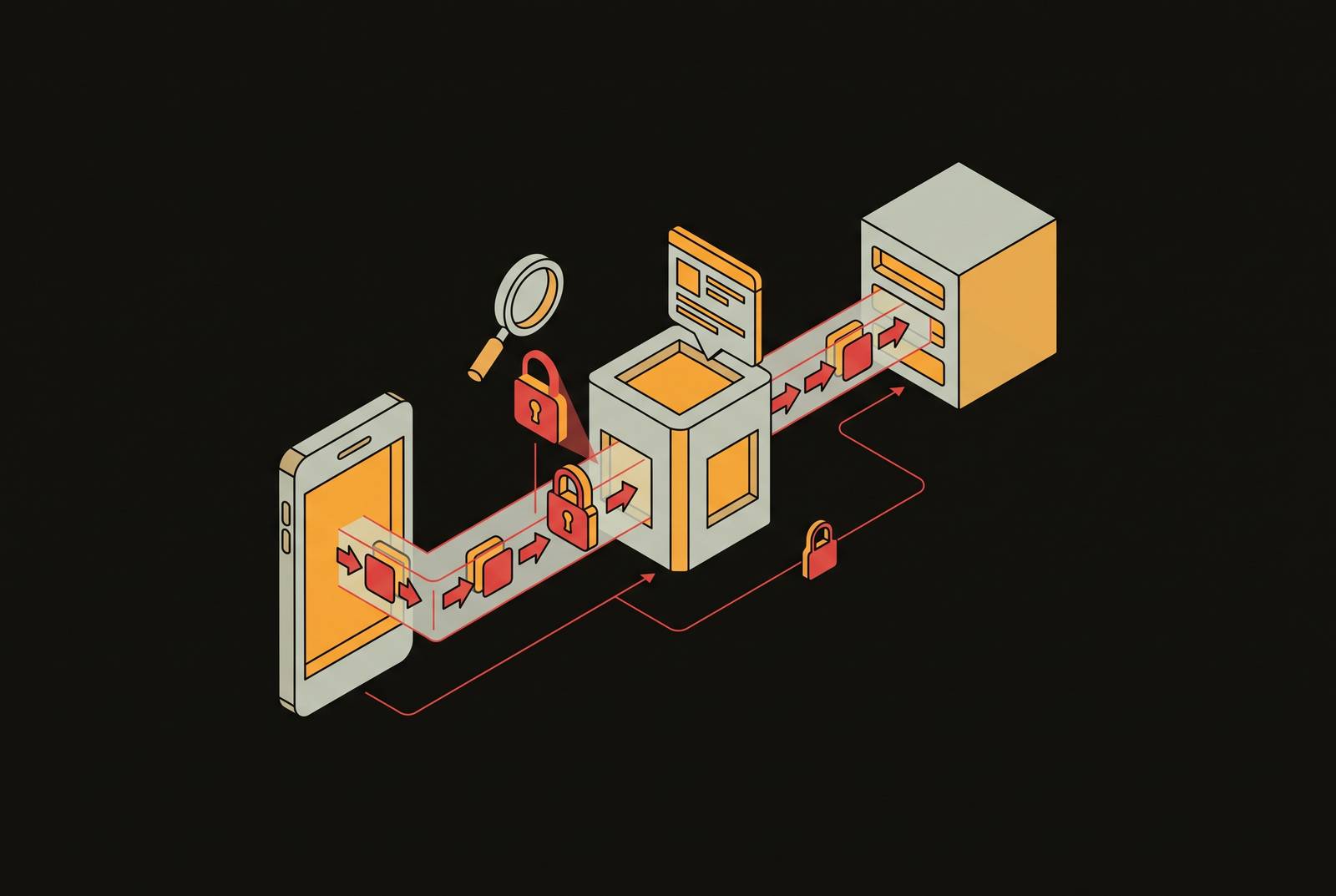
That starting point changes how a test should be scoped. A mobile device has to be treated as hostile territory: root access, decompilation, and runtime tampering are all available to anyone determined enough, so nothing on the client side can be trusted to hold the line on security. A mobile app test typically covers three layers: static analysis of the binary, dynamic analysis of the app at runtime, and analysis of the backend API it calls. The third layer is where the exploitable logic actually sits. The clearest example: a backend endpoint accepts a user ID straight from the client because the app's own interface never gives a user a way to type in or change that ID manually. The field doesn't exist in the UI, so nobody thinks to protect it on the server. A proxy sitting between the app and the server can swap that one integer for another user's ID in a matter of minutes, and if the server answers, the authorization check was never really there. Automated static scanners and binary-only tools cannot catch this. They can read a decompiled app all day and never see how the server behaves, because that behavior appears only when a live request reaches it.
What the proxy intercept layer actually reveals that other methods cannot
A proxy sitting between the app and its server does something static analysis and automated scanning cannot do: it shows what the server actually does when a real, authenticated request gets changed mid-flight. Static analysis of the binary turns up hardcoded secrets, weak configuration settings, and leftover debug flags, all useful, but a different category of finding from an authorization bypass.
Automated scanners run a fixed checklist. A person working through proxied traffic does something a checklist can't: notices an OAuth token sitting in a request, then tests whether that same token opens the door to another user's data somewhere else in the API. That kind of reasoning, noticing a detail and chasing it to see what it unlocks, is not something a scanner replicates.
Once traffic runs through a proxy, several things become visible at once: every endpoint the app actually calls, the exact shape of its auth headers and tokens, every identifier (user IDs, account IDs, resource IDs) the app hands to the server, and how the server responds when those values get changed. The finding this method is built to catch is broken object-level authorization, often called BOLA or IDOR: authorization enforced only in the app's interface, with nothing backing it up on the server. It stays invisible right up until someone swaps an ID in a request and replays it. For this reason, testing through the app's own screens is not enough on its own. Direct API testing through a proxy belongs in the scope of every mobile engagement, because the authorization bypass class of bugs is visible only through requests sent straight to the API.
Clearing the first obstacle: getting traffic through the proxy when the app resists
Before any of that testing can happen, the app has to let the traffic through, and most production apps are built not to. Mobile apps put up certificate pinning and anti-instrumentation checks as the first wall against interception, so you have to get past them before anything else.
Certificate pinning, where it's implemented, breaks the proxy outright: the app refuses the proxy's CA certificate and the TLS handshake never finishes. The standard way around this is to use Frida scripts or a tool like Objection to hook the function that validates the pinned certificate, force it to report success, and let the connection through to Burp Suite or mitmproxy.
Getting to that point takes a specific setup: a rooted Android device, either a physical Pixel running Magisk or a Genymotion emulator, or a jailbroken iOS device; the Frida server running on the device with the Frida client and Objection running on the workstation; and the proxy's CA certificate installed at the system level, since Android 7 and later will not honor a certificate installed only at the user level. Before moving forward, confirm three things: the app launches normally, HTTPS traffic shows up readable in the proxy, and Frida attaches to the running process without crashing the app or triggering its detection logic. Only once all three check out is it time to move on to actual API testing. Some apps add anti-emulator or anti-jailbreak checks on top of pinning, and those need their own Frida hooks before pinning bypass is even possible, so you should treat all of it as one combined setup phase. The mistake to avoid: treating a successful pinning bypass as the finish line. Getting traffic to appear in the proxy only opens the window. The testing of what passes through that window is the actual work.
The vulnerability classes that proxied traffic exposes in mobile API authentication
With traffic flowing cleanly through the proxy, the real testing priority is the set of flaws that appear when client-supplied parameters, tokens, and identifiers can be freely rewritten.
Broken object-level authorization is the first and most common. The technique: intercept a normal, legitimate request, swap the object ID in it for a different user's ID, and replay it. If the server hands back data or accepts the change, BOLA is confirmed. The app's UI hides this flaw by design, since it never renders that field as something a user can edit, so the only way to see it is to manipulate the raw request directly. To cover this properly, work through every endpoint the app calls and replay each one with modified user IDs, tokens, and roles, checking each time whether the server actually enforces authorization itself or just trusts whatever identifier the client sends.
Closely related is the broader problem of client-trusted identifiers. Any backend that pulls the user ID, role, or tenant ID straight from the request body or headers, rather than deriving it from the authenticated session token, is exploitable the moment a proxy is in place. The test pattern is simple: change a role or privilege field in a request and see if the server honors it. If it does, the server side has no real enforcement. Mass assignment is a cousin of this issue: an API that accepts and applies every field sent in a request body, with no allowlist restricting which fields can actually be set, can be used to escalate privileges or modify records a user has no business touching.
Rate limiting, or its absence, is the third class you need to test directly. Login, OTP, and account recovery endpoints without rate limiting are open to credential stuffing and brute-force attacks, and this is a flaw that static analysis simply cannot see. It only shows up by sending repeated requests through the proxy and watching how the server reacts. Tools like Burp Suite's Intruder or Repeater can fire high volumes of authentication attempts at an endpoint, and the test is whether the server throttles them, locks the account, or just answers every single attempt the same way.
JWTs are the fourth area. A JWT intercepted in the proxy can be decoded directly, since the payload is base64-encoded, not encrypted, by default. From there the tests include algorithm confusion (switching the header's algorithm to "none," or swapping RS256 for HS256), stripping the signature entirely, and editing claims like user ID, role, or expiry. A server that accepts a token with its algorithm set to "none," or one with no signature at all, has no meaningful authentication running on that endpoint.
Session handling is the fifth. Capture a valid session token before you log out, log out through the app as normal, then replay that token against the API. If the server still honors it, logout isn't invalidating the session server-side. A similar test applies to refresh tokens after a password reset: a refresh token that still works after a credential change is a standing account takeover path.
Biometric authentication is the sixth. Android's BiometricPrompt and iOS's LAContext can both be bypassed with Frida hooks on a rooted or jailbroken device, unless the app binds the biometric check to a cryptographic key, using CryptoObject on Android or a Keychain item bound through SecAccessControl on iOS. The proxy is what reveals whether a biometric success is actually validated by the server or whether the app just sends a boolean flag or predictable token that the server accepts without question. If it's the latter, a local bypass alone is enough to take over the account.
Hardcoded Secrets and the API Attack Surface
Hardcoded secrets pulled from the binary during static analysis don't count as a separate finding on their own. They're credentials, so you need to test them against the live API before you can say how dangerous they actually are.
Hardcoded API keys and secrets turn up constantly in mobile pentests, and how severe each one is depends on what that key can unlock, from informational to critical. If it's a Google Maps API key sitting in a binary, that's a minor issue. An AWS key with broad permissions sitting in the same binary is critical. That distinction only becomes clear by testing the key against the live API, not by reading it off the decompiled source. Once a key turns up through reverse engineering, treat it as fully exposed: any user who downloads the app from the store has access to it too.
The proxy technique here is direct: take the discovered key, drop it into an intercepted request as an Authorization header or a query parameter, and watch what it opens up, whether that's new endpoints, user data, or administrative functions nobody intended to expose. Static analysis also tends to find hardcoded backend URLs for both production and staging environments, and staging often has weaker authentication than production. With the proxy, you can test both environments side by side, under identical conditions, and see how much weaker staging really is.
Whitebox Access and Proxy Testing
How much a tester knows about the backend going in determines how deep the proxy testing can go. Access to API documentation, source code, and cloud configuration opens up a different scale of finding, because a tester who understands how the authorization model is supposed to work can spot the exact places where it doesn't.
In a blackbox engagement, the tester only learns about endpoints by watching what the app itself calls through the proxy. Anything outside of normal app flow, administrative routes, undocumented parameters, stays invisible. Greybox access changes that: with API documentation and test accounts provided, the tester knows what endpoints exist and what they're supposed to do, which allows systematic testing of every authorization boundary rather than only the ones the app's own screens happen to touch. Whitebox access goes further still: with source code and cloud configuration in hand, a tester can read the authorization middleware directly, spot exactly where server-side checks are missing or only partially applied, and go straight at those code paths through the proxy. Logic flaws that might take weeks of blind enumeration to stumble onto in a blackbox test, if they're ever found at all, become visible quickly through this direct code-path testing.
Most enterprise engagements run greybox: documentation and test accounts, but no source code. Whitebox finds more logic flaws in less time. The scoping mistake that undercuts a lot of mobile testing is including the client but leaving the backend API out of scope. So the report ends up covering only the thinnest slice of the actual attack surface, missing exactly the authorization failures that whitebox API testing is built to catch. If you're a SaaS company operating in fintech, healthtech, or other high-trust environments, whitebox coverage of the API authorization layer is what separates a test that checks a compliance box from one that finds what a skilled attacker would actually find.
Building a documented attack chain from proxy findings to meaningful impact
The real value of mobile API auth testing is a documented attack chain showing how individual findings link together into something with real business consequences: account takeover, data exfiltration, privilege escalation.
A path to compromise reads like a narrative: it starts at one specific entry point, moves through a specific sequence of findings, and ends at a specific objective that actually matters to the business. A realistic example, built from the classes already covered here: a hardcoded staging API key appears in static analysis. The proxy confirms that key grants direct access to the staging API, which runs weaker authentication than production. From there, you can use a BOLA flaw on a user data endpoint, with no rate limiting and no object-level check behind it, to exfiltrate another user's session token. That token leads straight to a production account takeover.
Every step in that chain needs a working exploit behind it. A finding without a proof-of-concept is just a hypothesis, not a confirmed vulnerability, so you need a captured, reproducible proxy request for every mobile API auth finding showing how it works. A report that lists issues individually without showing how they chain together into something meaningful reads like a compliance exercise, not a real test of what an attacker could do. A report worth the name includes specific finding titles, the exact endpoint paths involved, the literal request and response captured from the proxy, a working proof-of-concept with clear evidence of impact, and remediation advice tied directly to the specific authorization failure, not generic advice copied across findings.
Where continuous API scanning fits after a point-in-time proxy-based assessment
A proxy-based test captures one version of the API on one specific date. Every pull request that touches an endpoint, adds a parameter, or changes authorization logic after that date opens up new surface that the test never saw, unless security checks are built into the development pipeline itself.
A single point-in-time test proves that a specific set of endpoints met a security bar on the day it ran. It says nothing about what happened in the months before that test or what happens in the months after. Mobile apps ship updates often, and each update that changes an endpoint, adds a parameter, or refactors authorization logic is a chance for a security control the pentest validated to quietly regress. Catching that regression means scanning on every API change, flagging anything that deviates from the authorization patterns already established, with a person reviewing anything that touches authentication or authorization directly.
Frameworks like SOC 2 (under control CC4.1), HIPAA (through its Security Management Process and related audit control standards), and ISO 27001's Annex A controls all call for ongoing monitoring, not just a single annual check. A pentest letter satisfies the annual evidence requirement auditors ask for, but continuous scanning closes the space between tests that auditors are paying closer attention to. If you're on an engineering team at a growth-stage SaaS company, the practical setup is a rigorous annual whitebox pentest with working exploits validated end to end, paired with continuous scanning at the pull-request level to catch the regressions that happen between one test and the next.