API Rate Limiting Bypass and Enumeration Amplification
Attackers bypass rate limits through header forgery and GraphQL batching to enumerate data at scale.
A team ships an API with rate limiting turned on: thresholds are set, dashboards are green. Three weeks later, an attacker has used that same endpoint, the one the rate limiter was supposed to guard, to enumerate forty thousand user records. The control was there, but it didn't hold. Enumeration, credential stuffing, and resource exhaustion keep succeeding at scale across the 2026 API security landscape even though rate limiting sits in nearly every modern API stack. The reason has nothing to do with thresholds being set too high. Attackers don't overpower rate limits by brute force, they go around the layer where the counting happens. APIs talk machine to machine. No browser renders a page, no DOM slows anything down, and nothing about a UI forces a human pace onto the traffic. Every parameter can be sent at any volume, in any structure, as fast as a script can generate it. The only thing standing between ordinary use and abuse is the logic built into the rate limiter itself, and that logic has gaps.
How limits get counted
Rate limiting sounds like one control. It's actually a stack of separate decisions, and each one opens its own door. The first decision is what to count: raw requests, individual operations, or tokens of compute cost. The second is what to count against: an IP address, a user ID, an API key, or a specific endpoint path. The third is where to enforce the count: at the gateway, at the CDN edge, or at the origin service itself. Every one of these decisions, made correctly or not, creates a matching way to slip past it.
IP-based counting is the default most teams reach for first, and it's also the easiest to defeat. The limit kicks in before a user ever authenticates, so an attacker who rotates to a fresh IP address gets a fresh counter every time. The same design punishes innocent traffic too: a corporate network sitting behind one NAT address can burn through the shared limit and lock out every employee behind it. The fix is structural: it means changing the design, not tuning the number up or down. Strict per-IP limits belong on unauthenticated endpoints only. Once a token validates, the system needs to switch to tracking the verified user ID or API key instead. Identity has to come before counting, not after.
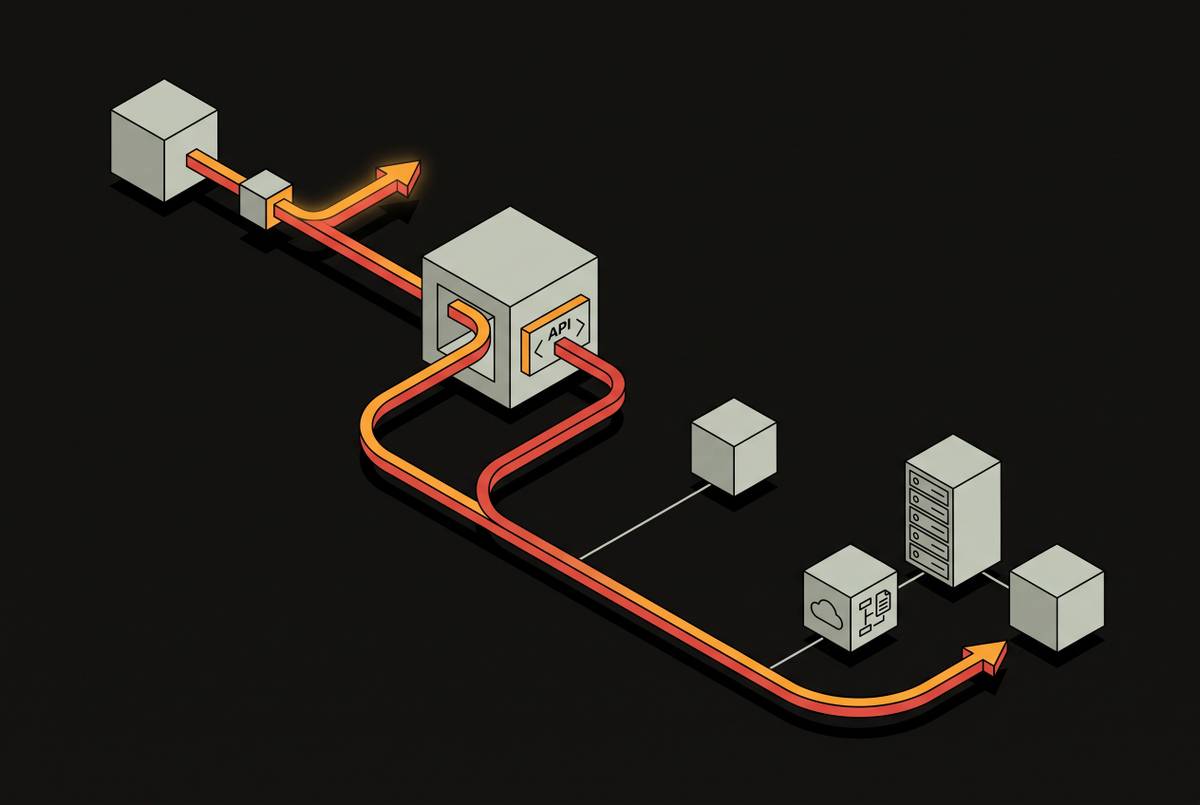
A second gap opens between the edge and the origin. If a CDN or a web application firewall holds the rate-limiting logic, but the origin server can still be reached directly, then any request that skips the edge resets to a counter that was never enforced. A third gap comes from how the system reads a URL. If the limit identifies an endpoint by its literal string, a trailing slash, a capital letter, a URL-encoded character, or a different version prefix can make the exact same endpoint look like four different ones to the counter. A fourth comes from HTTP method variation: a limit written for POST requests does nothing if the same operation can be triggered through PUT or GET instead. None of these are exotic. They're the direct consequence of a counting decision made at design time. Fixing them means revisiting the decision, not adding another rule on top of it.
Header forgery as the fastest bypass in practice
The fastest bypass in practice doesn't need any of that complexity. It needs one forged header. Many applications trust X-Forwarded-For or X-Real-IP to tell them who the client is, so if you control that header, you control what the rate limiter believes it's counting. Each request carries a new, made-up value, so the counter resets every time.
This isn't some obscure corner case a tester stumbles onto by accident. Proxy header abuse appears directly in rate-limit bypass technique references, and it's one of the first things a competent API pen tester checks. The trust exists for a real reason: CDNs and load balancers rely on these headers to pass along the real client address for legitimate purposes, like logging and geo-routing. That's why an application has to make an explicit choice to validate or strip these headers rather than inherit a default that trusts them blindly.
This gap stays invisible in monitoring because the counter increments against whatever fake value the attacker sent, the real attacker IP never touches the rate-limit accounting at all, and any alert built on threshold violations stays silent through the entire attack.
GraphQL batching and aliasing as enumeration amplifiers
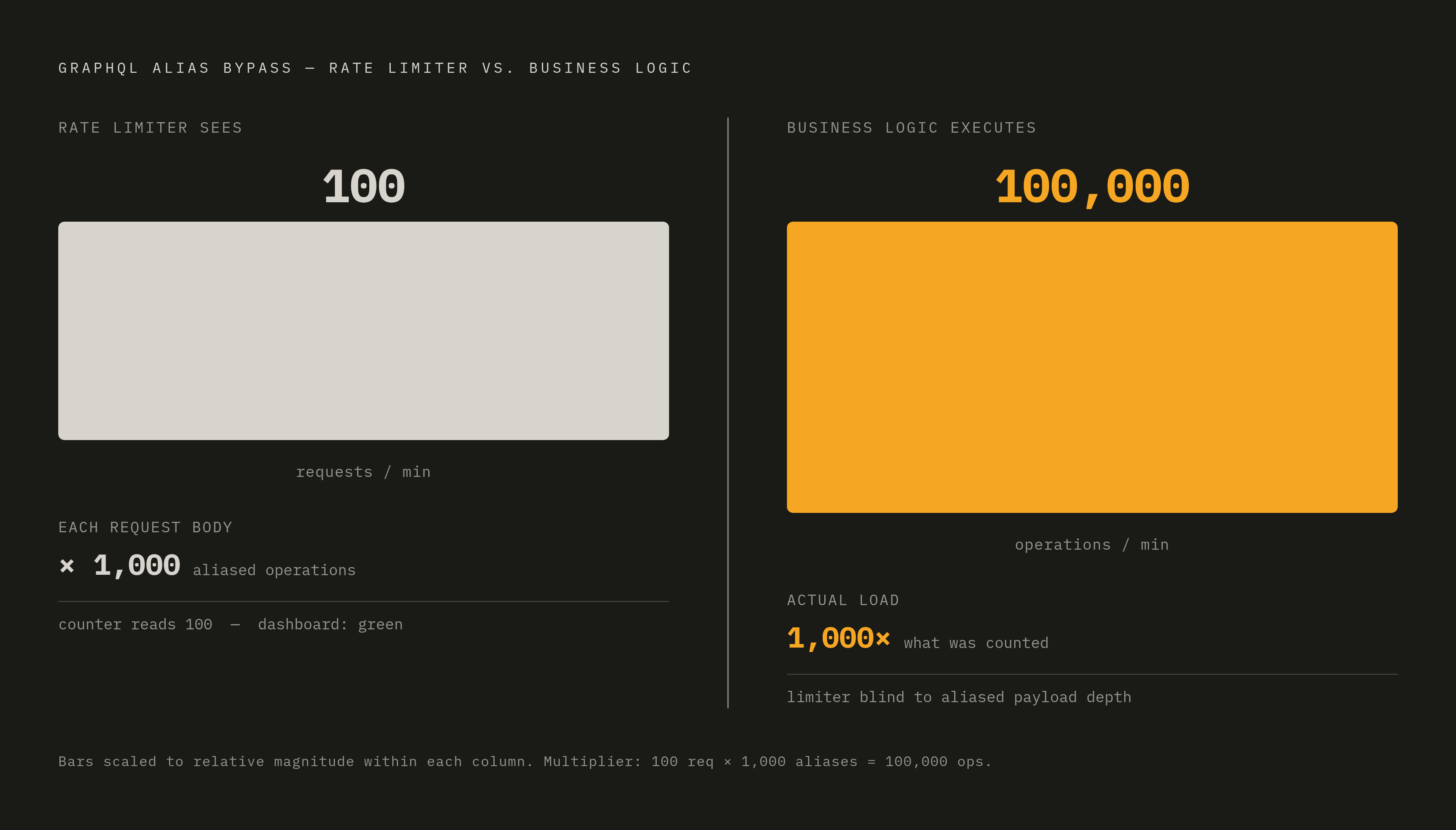
GraphQL introduces a bypass that doesn't just slip past a limit, it multiplies what a single request can do. Field aliasing lets an attacker package a thousand distinct operations inside one HTTP call: a thousand credential checks, a thousand discount code guesses, a thousand OTP attempts, all wrapped in a single request body. An HTTP-level rate limiter sees one request, so it only counts one. Alias-based bypass is a documented, named attack class used specifically for login brute force, OTP brute force, and coupon or account enumeration, all built from the same request structure.
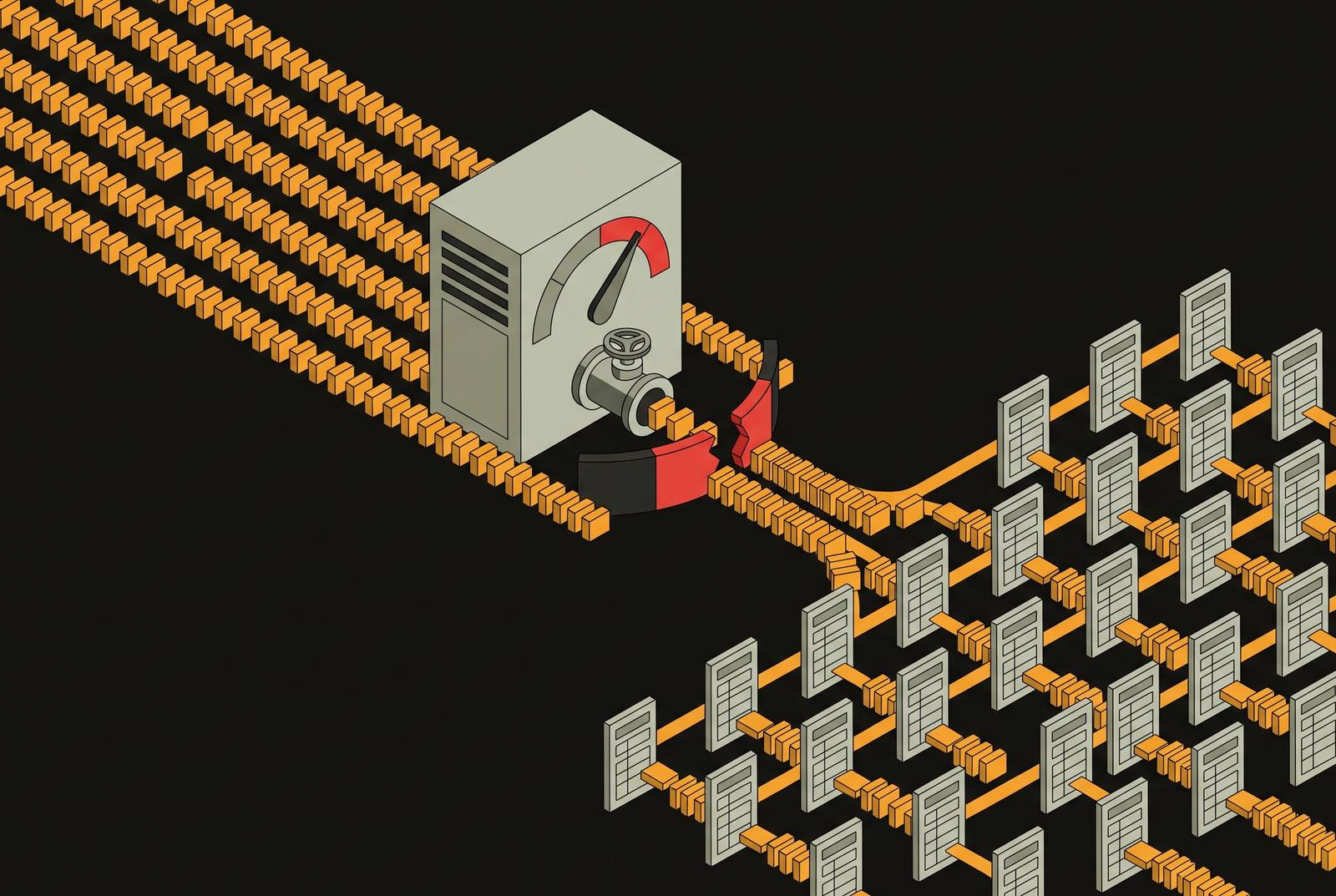
Query batching works alongside it. A single POST body can hold an array of separate operation objects, and depending on how the server handles it, those operations can run sequentially or even concurrently, but they still land as one entry against the counter. The math here isn't additive, it's multiplicative. If an attacker is capped at a hundred requests per minute but batches a thousand operations into each one, they run at a hundred thousand operations per minute against the application's business logic, while the rate limiter's dashboard shows traffic that looks completely normal.
Attackers don't have to guess which fields are worth targeting either. GraphQL APIs frequently leave introspection turned on in production, and introspection hands over the entire schema, every type, every field, every argument. An attacker can map the whole API first, then decide which operation is worth amplifying. Fixing this means changing what the rate limiter counts. Aliases and batched operations each need to count as a separate unit, and query depth plus field duplication need their own hard limits, so a single request can only carry so much computational cost.
BOLA enumeration: why authorization failures turn rate limit gaps into breach chains
Bypassing a rate limit is a mechanism. What it leads to is the reason it matters. Broken Object Level Authorization, known as BOLA or IDOR, is the top entry on the OWASP API Security Top 10, and it's the root cause behind some of the most consequential API breaches on record, including the Optus breach, the Twitter user scrape, and the T-Mobile record exfiltration. The pattern repeats across these incidents: the API checks whether a request comes from someone logged in, but never checks whether that person owns the specific record being requested.
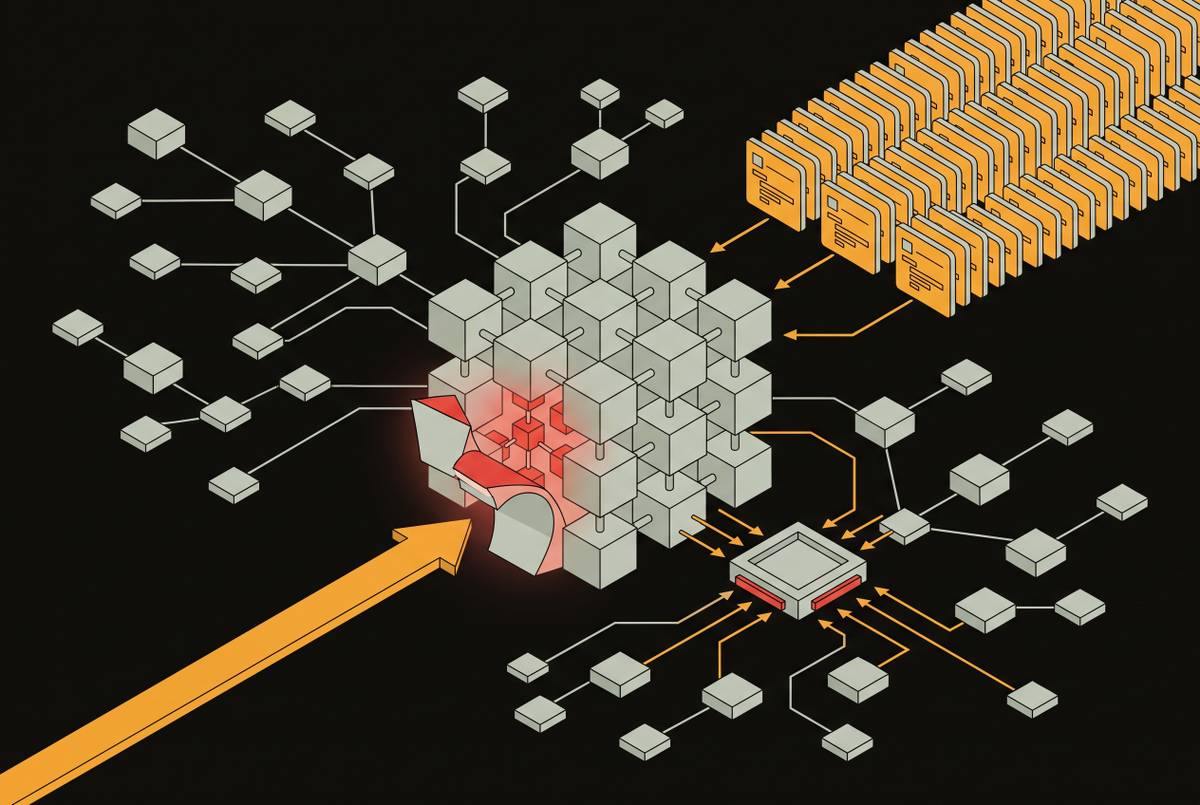
Exploiting this takes nothing more sophisticated than counting. An attacker authenticates once with a valid token, then changes the object ID in the request, a user ID, an account number, a document reference, and gets back someone else's data. Do that across a sequential or guessable range of IDs and the result is horizontal privilege escalation running at whatever speed the rate limiter allows.
That's the whole reason the rate limit matters here: it's the only infrastructure-level control standing between a slow, manual authorization flaw and a fully automated breach. Static analysis tools struggle to catch BOLA because the flaw lives in business logic, and a scanner can't recognize a code pattern for that. Dynamic scanners without real authentication context can't exercise the scenario. And at the network level, thousands of sequential requests to a parameterized endpoint look like ordinary API traffic. Spotting the problem takes understanding what that parameter represents and noticing that its values are being walked through in order, something no packet count alone will reveal. Rate limiting and authorization checking have to be validated together, because either one failing alone still causes damage: a rate limit that holds but an authorization check that fails still leaks data, just more slowly, and an authorization check that holds but a rate limit that fails still leaves the enumeration surface wide open to automation.
Financial amplification: when enumeration exhausts budgets, not just data
Data exposure isn't the only cost. Plenty of API endpoints trigger metered third-party services behind the scenes, SMS gateways, email delivery providers, payment processors, cloud inference APIs, and an attacker who bypasses the rate limiter on one of these endpoints can cause direct financial loss without ever touching a protected record.
OTP and SMS send endpoints are the most common target. If you leave one unprotected, an attacker can drain the SMS budget and flood real users' phones with messages they never asked for. The cost lands on the invoice, and the reputational damage from users getting spammed compounds it. A related class involves cloud infrastructure: APIs that kick off compute-heavy operations or provision cloud resources without a per-client cap can be driven to run up the infrastructure bill through deliberate overuse. OWASP classifies this as API4:2023, Unrestricted Resource Consumption, and the category covers more than request frequency. It also covers data volume per response, query nesting depth, and the raw computational cost of a single request, and every one of them can be amplified through the bypass techniques already described. A team that treats rate limiting purely as an uptime safeguard is missing half of what it's actually protecting.
Pen Test vs. Automated Scan
Automated scanners work at the protocol level. They fire known payload patterns, check the response codes that come back, and flag matches against known CVEs. None of that touches the bypass classes described above, because testing them requires understanding how an application counts, how its authentication flow works, and what its business logic actually does. A scanner that sends a burst of rapid requests and watches for a rate-limit response code confirms that some limit exists somewhere. It says nothing about whether that limit can be sidestepped with a forged header, a normalized path, a swapped HTTP method, or a GraphQL alias trick.
The findings that matter most tend to come from reading the OpenAPI spec line by line, reverse-engineering a mobile app's network calls, tracing the authentication flow end to end, and understanding what the business is actually trying to do with the API. None of that is something an automated scanner performs. Testing for BOLA enumeration specifically requires a tester holding valid credentials for more than one account, able to reason about who's supposed to own which object. That in turn requires whitebox access to understand how identifiers get assigned.
That access, to source code, cloud configuration, and the API specifications themselves, is what makes it possible to find the counting architecture gaps, the header trust assumptions, and the authorization logic failures before an attacker finds them first. Scans that run without this depth of access will miss every bypass class covered in this article, because the bypasses live in architecture and logic, not in a payload signature.
Controls that hold: designing rate limiting to survive the bypass classes
Rate limiting that survives these bypass classes counts at the right layer for each threat, not at one layer for every threat. Unauthenticated endpoints need strict IP-level limits. Everything behind a token needs limits tied to the verified user ID or API key, enforced after validation, not before. GraphQL needs operation-level counting, not request-level counting. Metered upstream calls need their own consumption-level limits, separate from the general request limit.
Header trust has to be an explicit, documented decision. X-Forwarded-For and similar headers should only be accepted from a known, trusted set of proxies, and that list belongs in active configuration, reviewed on purpose, never left as whatever the framework shipped with by default. Edge and origin enforcement has to line up. If a CDN or WAF holds the rate-limiting logic, the origin has to be unreachable by any path that skips the edge, because an edge limit with an open back door isn't a limit at all, regardless of how tight its threshold is set.
GraphQL needs its own set of specific controls: introspection disabled or restricted in production, aliases and batched operations each counted as their own rate-limit unit, hard limits on query depth and field duplication, and a computational cost budget enforced per query. For endpoints that call out to metered services, you need per-client consumption limits at the application layer, no matter what limits the upstream provider already enforces on its own side. An attacker going after an SMS gateway or a cloud inference API isn't trying to spend the provider's budget. The target is the budget that belongs to the team running the API, and the only control standing in the way is the one built to count correctly, catch the forged identity, and close the door the architecture left open.