Multi-Tenant Data Isolation Bypass in SaaS Applications
A single architectural flaw in multi-tenant systems can expose every customer's data at once.
IBM puts the average global cost of a data breach at several million dollars as of 2024. Cross-tenant data exposure caused by misconfigured APIs has increased by 17% across SaaS environments. Read together, those two numbers point at something specific about how modern software fails: a breach isn't one customer's problem anymore. It hits everyone on that infrastructure at once, and the bill scales with the number of tenants affected, not the size of the flaw that caused it.
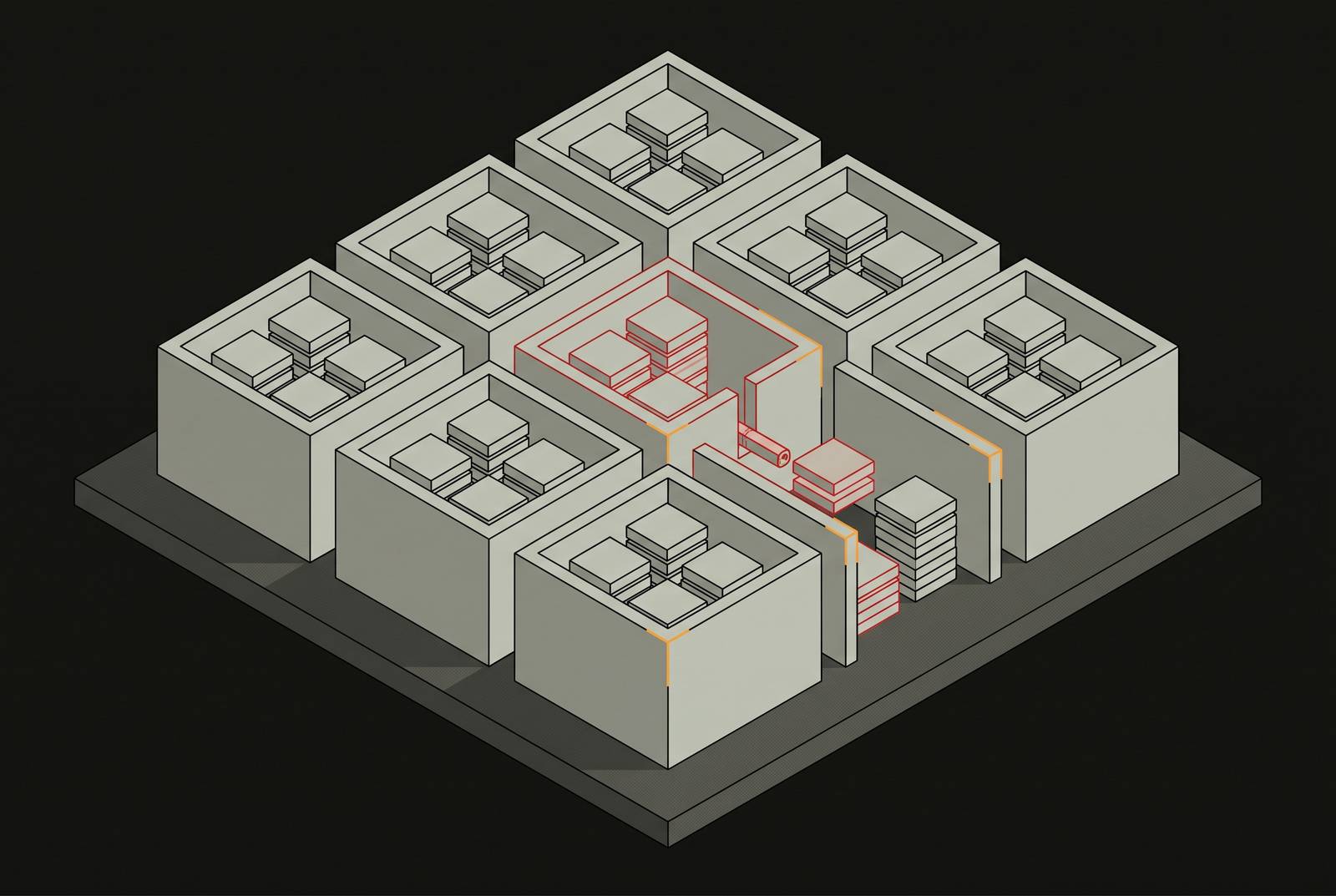
That's the core fact of multi-tenant architecture. The same database, the same cache, the same background job runner that makes SaaS cheap to run is the thing that turns one bug into a mass event. A flaw in a single-tenant system hurts one customer. A flaw in shared infrastructure hits every customer on it the moment someone finds it, whether that someone is a researcher, an attacker, or a customer poking around where they shouldn't be.
The business math turns ugly fast from there. Every affected tenant can trigger its own breach notification, its own contract review, its own conversation about walking away. One incident becomes as many crises as there are affected accounts. Enterprise deals that were mid-pipeline stall out in due diligence. Acquirers who find systemic isolation problems during a security review rarely walk away outright, they just cut the price, and significant valuation discounts are common once a buyer's technical team discovers that tenant boundaries were never actually enforced at the infrastructure layer, which is the only layer where enforcement counts.
None of this comes down to one bug. It's a class of architectural failure that appears in query logic, in connection pooling, in API authorization, in analytics pipelines, and now in AI agent runtimes. Fixing it starts with knowing exactly where each failure mode lives, and most teams don't, because they've only ever tested the layer that's easiest to see.
What multi-tenant isolation means across the four layers where it can break
Isolation gets talked about like it's one setting you flip on. Isolation is not one setting you flip on; it's a property that has to hold, at the same time, across four separate layers: data storage, identity and authorization, resource consumption, and analytics or reporting. It's a property that has to hold, at the same time, across four separate layers: data storage, identity and authorization, resource consumption, and analytics or reporting. Most teams pour their effort into the first layer and quietly assume the other three came along for free. Most teams poured their effort into the first layer and quietly assumed the other three came along for free.
Data isolation is the one most engineers picture first: every query, every join, every export, every background job scoped correctly so tenant A never touches tenant B's rows. It's the most visible layer, and, not coincidentally, the one teams spend the most effort defending. That's also why the most visible layer is rarely the one that actually fails first.
Identity and access isolation is subtler, and it's where a lot of SaaS companies quietly get it wrong. Authentication answers "who is this user." Authorization has to answer a second, harder question: which tenant does this user belong to, and what inside that tenant are they actually allowed to see? Treating those as the same problem lets the system correctly identify a person while handing them someone else's data.
A failure in resource isolation first appears as a performance complaint, in the slowdown users feel, before anyone realizes it's a security one. One tenant runs a heavy batch job or a report with a bad query plan, and every other tenant sharing that database feels the slowdown. In a usage-based billing model, that's not just a latency complaint, it's a billing accuracy problem: work gets attributed to the wrong account, and the metering the whole revenue model depends on drifts quietly away from reality.
Leaky queries and missing tenant filters silently expose cross-tenant data
Exposing cross-tenant data doesn't take a skilled attacker. It takes one missing condition in one query, join, export job, or background task. That's the entire bar, and it's a low one.
The pattern plays out the same way almost every time. A developer, working under deadline, adds a new query path. They scope it to the current tenant in the application layer, maybe with a filter in the controller or service class, and ship it. What they don't do is push that same restriction down to the data layer itself, which is the only place a tenant filter is actually safe to rely on. Application-layer scoping is a suggestion. Data-layer scoping is a guarantee, and treating the two as interchangeable is where this failure mode starts.
Three common patterns handle this differently, and each breaks in its own way under pressure. Row-level filters, a tenant_id column checked in every query, are cheap and common, but fragile: once queries get built dynamically, or a database abstraction layer hides the WHERE clause, it's easy to add a new query path that never gets the filter attached. Schema-level separation, one schema per tenant inside a shared database, gives a stronger boundary but adds real operational weight, since every migration now has to run against every schema, and a missed migration on even one creates drift that's hard to catch until something breaks. Database-level separation, a fully separate database per tenant, is the strongest boundary available. It's also the most expensive, and rarely practical across an entire tenant base, so most companies save it for their largest or most sensitive accounts.
PostgreSQL's Row Level Security gets reached for as the fix, and it's a real defense, but not an unconditional one. CVE-2024-10976 showed that row security checks applied below subqueries, including WITH queries, security invoker views, and SQL-language functions, could ignore changes to the user ID the policy was supposed to be evaluating against. CVE-2025-8713 showed something quieter still: the query optimizer's own statistics, the histograms and most-common-value lists it builds to plan queries efficiently, could leak sampled data from rows RLS was designed to hide. A crafted "leaky operator" could pull that sampled data straight out of the optimizer's internals, sidestepping the row security policy. RLS is a real control, but it's no substitute for checking that every single query path actually respects it.
Connection pool leakage and shared caches crossing tenant boundaries at the infrastructure layer
Opening a fresh database connection for every request is expensive, so nearly every SaaS platform pools them, using something like PgBouncer, HikariCP, or Prisma's connection pool. That's standard practice, for good reason. It's also where a serious failure class starts.
A database connection carries session-level state. If a tenant's request sets that state with something like SET LOCAL to scope the session to a particular tenant context, and the connection goes back into the pool before that state is fully cleared, the next request to grab that connection inherits it, even if it belongs to a completely different tenant.
What makes this dangerous is that nothing looks wrong. No error fires, no log entry flags it. The query runs, returns a result, and the application treats it as correct, because syntactically it is correct. It's just running against the wrong tenant's data, and nothing in the stack is built to notice.
Shared caching creates a parallel version of the same problem. Building a cache key from a resource identifier alone, without the tenant ID baked into that key, leaves the cache unable to tell tenant A's version of "resource 4471" from tenant B's version of "resource 4471." Whoever asks first populates the cache. Whoever asks next, from a different tenant, gets served that same cached answer back. The platform is correct about the data yet blind to the fact that it's handing the right answer to the wrong customer. It's blind to the fact that it's handing the right answer to the wrong customer.
Broken object-level authorization and IDOR exposing tenant data through APIs
APIs hand attackers a far more direct path than a web UI ever does, because an API exposes the underlying operations instead of a rendered page wrapped around them. Manipulating a request just means changing a value inside it.
That's how Broken Object Level Authorization, or BOLA, also called IDOR (Insecure Direct Object Reference), plays out. A user from tenant A sends an API request and swaps a resource identifier, say an invoice ID or a document ID, for one belonging to tenant B. The API checks that the request is authenticated. It never checks that the authenticated user's tenant matches the tenant that owns the requested resource. The request succeeds, and the wrong customer's data comes back.
BOLA has sat at the top of the OWASP API Security Top 10 since that list first existed, and there's a reason it stays there: catching it takes understanding what a piece of data means and who it belongs to, well beyond checking whether an endpoint demands a valid token.
The most dangerous version of this is a business logic failure, not a coding mistake. It's a business logic failure: an API doing what it was built to do, correctly, where what it was built to do was insecure from the start. A scanner has nothing to flag, because there's no broken code to find. The system works exactly as designed. The design itself was wrong.
Analytics layers and reporting pipelines introducing isolation failures that bypass application controls
Analytics gets built and reviewed as a product feature, not a security boundary, and that gap is exactly where isolation tends to fail quietly. The team building a customer-facing dashboard optimizes for query speed and flexible filtering. Tenant boundary enforcement usually isn't even on their checklist.
A handful of failure points recur. Dashboards get built outside the application's permission logic, because the dashboard's query engine often runs its own database connection and constructs its own queries, neither of which inherits the tenant filters the main application enforces. Aggregations quietly span tenants: a "global" summary query, built for speed, rolls up data across the whole customer base and hands a slice of it back to a user who was only ever supposed to see their own tenant's numbers. Exports and scheduled reports leak across tenants too, when a job running under a service account, with no tenant context attached at all, pulls every row matching a date range and ships the result to whichever tenant's report template asked for that format first. Embedded analytics tools compound the problem, since third-party embedded analytics products carry their own data access model, and that model has to be explicitly configured for tenant isolation. Left at default settings, it's often permissive by design.
That 17% rise in cross-tenant exposure from misconfigured APIs tracks closely with these surfaces. Analytics and integrations are where isolation actually breaks in practice, ahead of the login page everyone tests first. The fix isn't a filter bolted onto the presentation layer after the query already ran. Analytics needs tenant context enforced at the data layer of the analytics engine itself, built in from the start, not patched on after someone notices a problem.
AI agent workloads introducing a new class of cross-tenant isolation failures in compute environments
Traditional SaaS isolation works because the vendor controls the code running on its own infrastructure. It's a known, reviewed set of operations, written by the vendor's own engineers, doing what those engineers intended.
AI agent workloads flip that assumption on its head. An agent generates and runs code at request time, based on a customer's prompt. The platform ends up executing code nobody on its team ever reviewed, shaped by input nobody on its team wrote.
OWASP's guidance for LLM applications says to treat the model like any other untrusted user, and apply real input validation to anything the model hands off to a backend function. Code the platform never reviewed is untrusted by definition, no matter how well-behaved the model usually seems.
Container isolation, the default answer to "how do we sandbox this," doesn't close the gap on its own. A container limits CPU and memory, but it still shares the host kernel with every other container running on that same node. A kernel-level exploit inside one tenant's container can reach the host, and from the host, every neighboring tenant on it. CVE-2025-23266 demonstrated a container escape enabling host-level access in multi-tenant environments. CNCF's analysis of the runc breakouts disclosed in November 2025 points to the same pattern: the flaws could be abused wherever a user runs a container built from a malicious or compromised image, and any multi-tenant environment letting users define their own containers carries that risk. AI agents, which by design run code shaped by user input, sit right in the middle of that exposure.
Why automated scanning cannot verify multi-tenant isolation
Automated scanners handle a narrow, useful set of things well: known CVEs against identified software versions, missing security headers, obvious injection indicators. Against the actual risk surface of a multi-tenant SaaS platform, that narrow set covers a small fraction of what matters, and treating a clean scan as proof of isolation is the mistake that gets companies burned.
Isolation failures are semantic. That's the whole problem. A scanner can confirm an endpoint demands a valid auth token. It can't confirm that the authenticated user's tenant membership was checked against the tenant that actually owns the resource being returned. That check takes understanding what the data is and who it belongs to, and that's a judgment call, not a pattern match.
Testing for IDOR and BOLA properly means provisioning two separate tenant accounts, making authenticated requests as tenant A for resources that belong to tenant B, and comparing what comes back against what should come back. That's a multi-step exercise that depends on context a single automated probe has no way to hold onto.
Catching leaked connection pool state or cache key collisions is even less scanner-friendly. Both need concurrent or carefully sequenced multi-tenant sessions, built specifically to induce the leak and catch it in the act. A single-request scan, run in isolation, will never trigger either condition, let alone detect it.
What a rigorous multi-tenant isolation test covers
A real isolation test has to cover all four layers above, including the parts of the API surface that are hardest to reach with automated tooling. Anyone who tells you a passing scan report counts as an isolation test is selling something.
At the data layer, that means walking every query path, every join, every export routine, and every background job, and checking tenant filter completeness at each one individually, not just spot-checking the endpoints that look busiest.
At the identity and authorization layer, it means testing every endpoint for both halves of the problem: does it require authentication, and separately, does it verify tenant-scoped authorization against the resource being requested? That coverage has to reach password reset flows, account recovery routes, and administrative API paths, not stop at the primary login flow that gets the most attention by default. Those secondary paths are exactly where tenant-scoping logic tends to get skipped, because they got built later, by someone assuming the main flow's protections would somehow carry over.
Credible results come from evidence rather than a summary score. A test worth trusting shows the actual request and response pairs across tenant boundaries, names the specific query paths and endpoints checked, and states which layers were tested and which weren't. Anything less is a scan wearing an isolation test's clothes.
Sources
- Tenant Isolation Guide 2026: Models, Risks & Best Tips for SaaS
- Medium
- Multi-Tenant SaaS Security Testing: Stop Cross-Tenant Leaks
- Multi Tenant Security - OWASP Cheat Sheet Series
- Designing Data Isolation and Authorization for Multi-Tenant SaaS: Harden the Tenant Boundary, PII Protection, and BOLA Countermeasures with 'The Trust Boundary Is the Server'
- navanathjadhav.medium.com
- stingrai.io
- agnitestudio.com