TruffleHog vs Gitleaks for CI Secret Detection
Gitleaks gates merges fast, while TruffleHog proves which leaks are live.
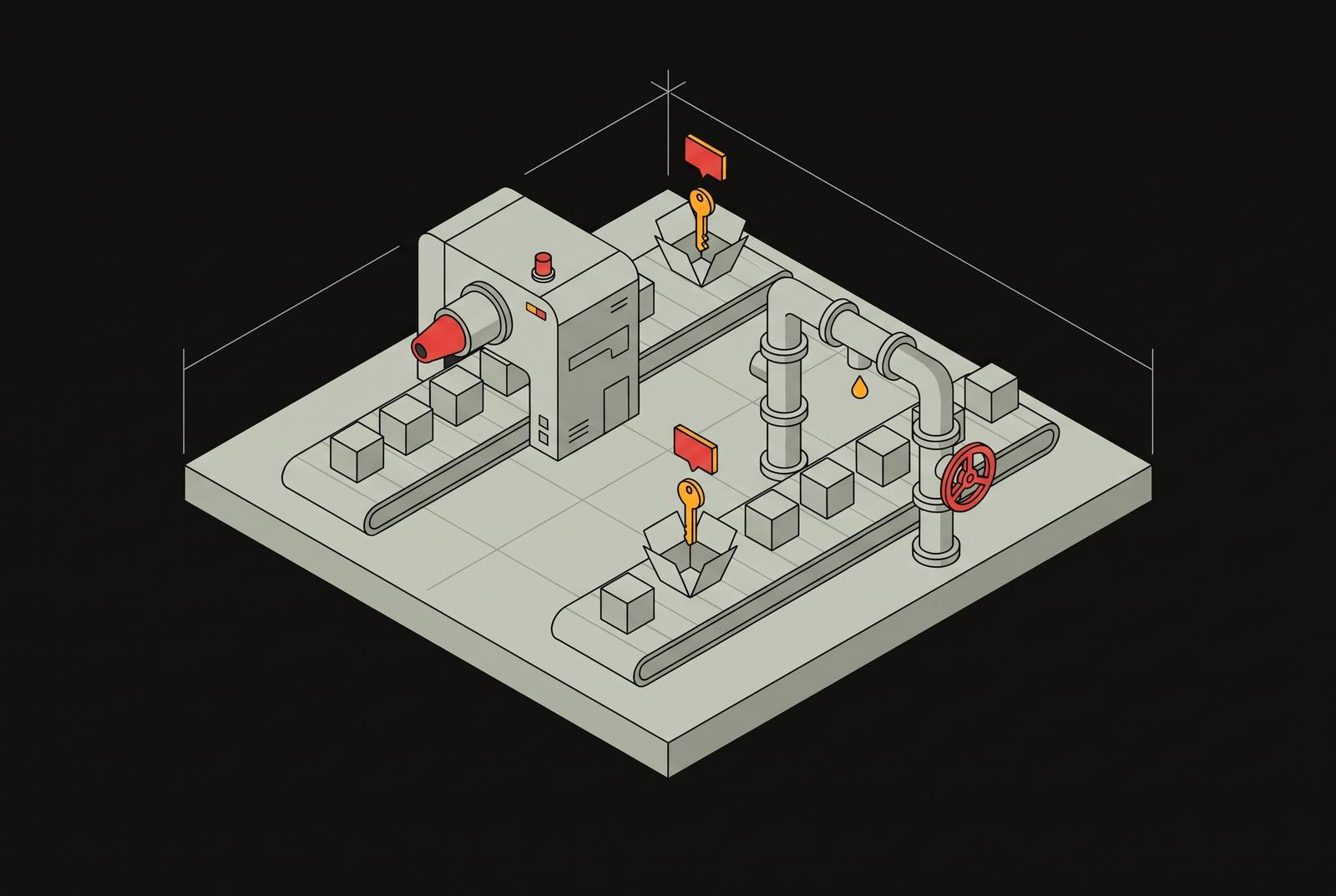
TruffleHog and Gitleaks answer different questions in CI secret detection. Gitleaks is quick to find strings that look like secrets. TruffleHog checks whether credentials actually work. The right choice is not one winner for the whole pipeline, but fast pattern matching before merge and live verification for deeper scans and incident response.
Why secrets in git history are a different problem than secrets in current code
Git history preserves what the current file hides. Removing a key in a new commit leaves the old value readable in earlier snapshots, clones, forks, and CI caches. A key removed two years ago can still authenticate today. Its absence from the main branch says nothing about whether someone can use it, which makes a clean working tree a poor measure of credential safety.
The risk therefore compounds as history grows. Old commits can hold both expired credentials and live ones, and both may look just as real to a pattern matcher. Finding the string establishes exposure, while confirming that it still works establishes an immediate response priority. On public repositories, automated exploitation attempts can begin within minutes of a push. That leaves little room to treat removal from code as remediation.
The core technical difference between pattern matching and live credential verification
Gitleaks uses regular expressions set in a TOML configuration to spot known secret formats. Shannon entropy also helps flag highly random strings that have no named format. Everything runs locally, with no contact with the provider and no network calls. A finding means something like “this string looks like a Stripe key,” not that the key works. Human triage still has a job to do.
TruffleHog first finds candidates with detectors and regular expressions, then tries to verify them with a live, read-only call to the provider API. Its results distinguish verified, unverified, and unknown credentials. That distinction changes the response. A verified active AWS key warrants a P1 incident, while a failed verification needs a different assessment. In verified-only mode, a credential that authenticates is not a false positive.
That certainty has a runtime cost. Gitleaks is a single Go binary that does local pattern matching and usually finishes modest diffs in under a second. TruffleHog adds an outbound call per candidate, so large or noisy histories bring network access and provider rate limits into the scan. The supplied benchmarks also show that neither tool finds every seeded credential. If both speed and verification are useful, the practical question becomes where each belongs.
What the benchmark data actually shows about detection coverage
The supplied benchmark records Gitleaks 8.24 finding 51 of 60 secrets, with 4 false positives. Misses clustered around provider formats without matching patterns and secrets assembled through string concatenation. TruffleHog partially caught the concatenated cases, while Gitleaks did not. The notes do not give a corresponding TruffleHog total for that benchmark.
A separate October 2026 test seeded 12 credentials. Gitleaks 8.30.1 found 10, while TruffleHog 3.99.7 found 9. Credentials without recognizable prefixes, including Django database passwords and JWT signing secrets, produced the widest shared gaps. Detecting a candidate and proving that it works remain separate measures.
Both tools need help with internal formats. Generic database passwords, internal HMAC seeds, and custom-prefixed tokens can evade their default rules. Gitleaks supports custom TOML rules, while TruffleHog supports custom detectors for verified types. Beyond repositories, Truffle Security’s June 2026 scan found hundreds of live credentials across thousands of public Hugging Face training datasets. These datasets are another place where secrets can leak, beyond the reach of ordinary pre-commit hooks or CI scans.
Where Gitleaks belongs in the pipeline and why
Gitleaks fits the gates where delays affect how long developers are willing to wait. A local pre-commit hook can block a known secret pattern before it reaches the server and return the file and line number immediately. Offline operation removes any dependency on provider availability. The pre-commit framework configures this through .pre-commit-config.yaml, with a pinned release for reproducibility. However, developers can bypass the hook with --no-verify, so local prevention cannot stand alone.
A CI diff scan closes that bypass path. On each PR, Gitleaks can scan commits added since the base rather than repeatedly raising historical findings already triaged. That keeps the gate under two seconds. SARIF output feeds GitHub code scanning dashboards, and a maintained GitHub Action supports the integration. When the job is a required status check, it must pass before a merge can go ahead.
An inline # gitleaks:allow suppresses a particular line, .gitleaksignore records findings by fingerprint, and [allowlist] in .gitleaks.toml handles known fixtures and examples. Its MIT license also avoids copyleft obligations for standard CI use. The source snapshot says v8.30.1, released 21 March 2026, is feature-complete and gets security patches only. For configuration, git, dir, and stdin replace the detect and protect commands deprecated since v8.19.0.
These gates address new commits and bypassed hooks. They do not establish whether a credential buried in an old commit still authenticates.
Where TruffleHog belongs in the pipeline and why
A full-history sweep may uncover many plausible secrets, but verification narrows emergency rotation work to credentials confirmed live. Weekly scheduled scans are a common baseline. Scans of the full organization belong in batch jobs instead of the primary PR gate because provider verification adds work for each candidate. An unknown result still needs assessment rather than being treated as proof that a secret is harmless.
Incident response makes the same distinction urgent. When compromise is suspected, a verified scan helps establish which credentials are currently active and across which repositories. TruffleHog can also scan PR changes with --since-commit {BASE_SHA}. In that role, it is a deeper pass that complements the fast pattern check. Verified-only output cuts alert noise, though it makes no claim to cover every secret format.
The execution environment needs attention as well. Verification needs outbound access to the provider, and large scans can hit rate limits. Raw output can also contain the live secrets the scan was meant to find. TruffleHog’s AGPL-3.0 license adds a separate constraint that some teams must resolve before deployment.
The AGPL-3.0 licensing constraint on TruffleHog and when it actually matters
AGPL-3.0 is a real dependency constraint for some organizations. Its source-disclosure obligations can extend to distributed software, derivative works and network service deployments. Incorporating TruffleHog into a platform or offering it as a service therefore requires legal review. Teams have replaced it with Gitleaks over licensing concerns. If organizational policy blocks AGPL dependencies, adding the scanner to a workflow still needs a licensing resolution.
Gitleaks has no equivalent copyleft requirement under MIT. GitGuardian’s CLI, ggshield, is also MIT-licensed, but it requires a GitGuardian account and API key because detection runs through GitGuardian’s API. It is not a self-contained substitute. TruffleHog Enterprise offers a commercial license, which turns the question into a purchasing decision outside the open-source stack.
Live secrets printed in CI logs that many people can read or that are unencrypted can leak a second time. Log handling therefore belongs in the deployment plan. For most teams running TruffleHog unchanged as a CLI against their own repositories, however, the licensing concern described here is not triggered. That leaves the combined architecture available without turning ordinary scanning into a service deployment.
The four-gate architecture that uses both tools in their right places
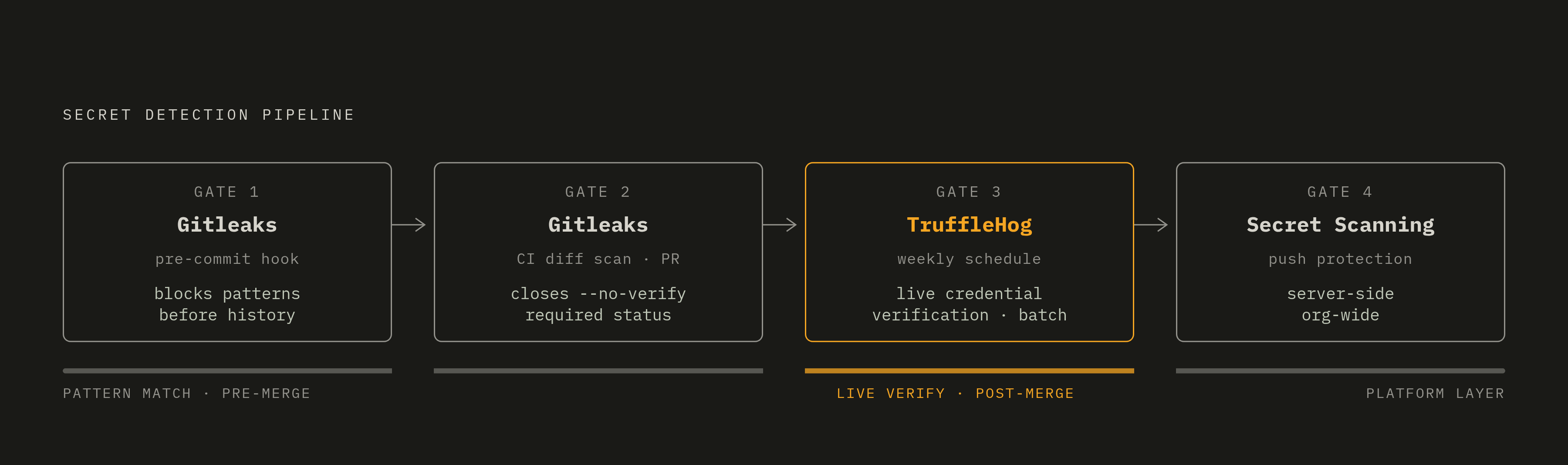
The recommended deployment uses four gates with distinct jobs. Gate 1 runs Gitleaks through the pre-commit framework, with a specific release pinned in .pre-commit-config.yaml. It blocks recognized patterns before they enter history. Because that hook remains bypassable, Gate 2 repeats the control in CI on every PR. Gitleaks should be the primary required status check there.
To scope that CI check, use gitleaks git --log-opts="origin/main.." for commits new to the branch against the base. Set the checkout’s fetch-depth value to 0 so the scanner can see beyond the latest commit. Shallow checkout defeats the intended history coverage. TruffleHog can run a complementary PR verification pass with --since-commit {BASE_SHA} and --only-verified --fail. Handle its exit code 183 distinctly so a secret finding is not confused with an ordinary job failure.
Gate 3 runs TruffleHog across full repository history on a weekly schedule. It also requires a complete checkout. For confirmed-live output, use --results=verified. A broader sweep can use trufflehog git file://. --results=verified,unknown --fail to retain unknown results for review as well. Those output choices serve different triage needs. The same history-scanning capability supports acquisition diligence and incident response without putting the batch workload on every merge.
Gate 4 adds platform-native push protection through GitHub Secret Scanning or the GitLab equivalent. This server-side gate can block a push before acceptance even when a developer bypasses the local hook. Enable it across the organization. Its high-confidence provider patterns reduce noise, but also leave generic passwords and internal formats outside its reach. Check the audit log each week for the reasons people bypassed push-protection so those exceptions get reviewed.
Custom rules address the gap between these gates. Known internal token types need a TOML stanza in Gitleaks or a custom detector in TruffleHog rather than an assumption that default coverage is enough. For regulated enterprises, GitGuardian can add governance dashboards, real-time public GitHub monitoring, and compliance reporting. That is an optional managed platform decision.
What to do when a verified secret is found — the rotation-first response
The first action is to revoke or rotate the credential at its provider, without waiting for evidence of exploitation. Removing the value from code does not revoke it. Neither does rewriting repository history undo access someone may already have gained to the credential. On a public repository, assume the secret was seen because automated bots watch pushes in near-real time.
Verified live production secrets must be rotated right away and handled as a P1 security incident. Confirmed-live test secrets should be rotated within one business day. After containment, check the provider access logs for the time the credential was exposed to see whether it was used. History cleanup comes later, and a force-push of rewritten history requires coordination because it invalidates open PRs and existing clones.
All four gates should feed one triage workflow. DefectDojo, Jira with a defined workflow, or a commercial platform can keep findings moving through consistent states, including verified live, verified revoked, and false positive. Separate queues make that lifecycle harder to maintain. A scan result needs an owner and a response path. Without a practiced rotation runbook, detection records the risk but leaves it unresolved.
To cut the risk of future exposure, replace long-lived API keys with OAuth 2.0 client credentials flows that use short token lifetimes. Ephemeral credentials can shorten credential lifetimes from months to minutes. Scanners still have a role in finding leaks.