Secret Scanning Tools Compared for SaaS Repositories
Match each scanner to its job, from commit blocking to remediation.
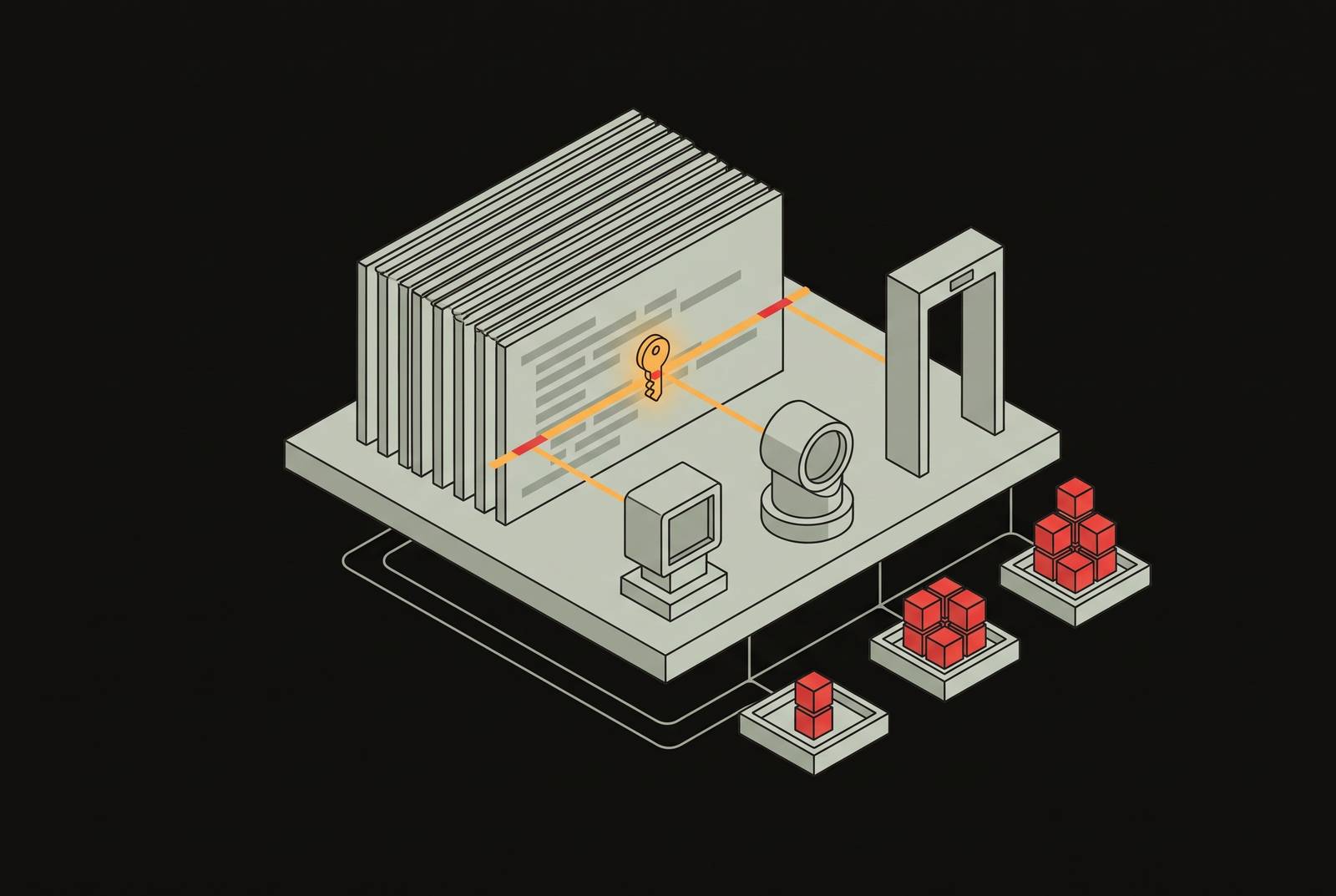
Secret scanning tools for SaaS repositories are not interchangeable. The defensible choice depends on which credentials they detect, whether they confirm those credentials are live, where they run, and what happens after an alert. A fast commit blocker and a remediation platform solve different problems. The strongest setup matches those jobs to the team’s actual exposure.
Why secrets in SaaS repositories are a distinct and growing problem
SaaS development creates secrets by design. Cloud services, databases, third-party APIs, and CI/CD pipelines all need credentials, which developers handle dozens of times a day. Internal repositories have a higher density of hardcoded secrets than public ones. Private does not mean clean.
Git makes each mistake harder to contain. Deleting a file leaves its credential in history, clones, forks, caches, and mirrors, which makes detection before a commit especially valuable. GitGuardian’s 2026 State of Secrets Sprawl counted more than twice the new secrets in 2025 that its 2024 edition counted for 2023. An inherited scanner choice deserves a fresh look.
The four functional jobs secret scanning tools are built for — and why conflating them produces false purchase confidence
Secret scanning covers four distinct operational jobs. Commit-boundary blocking catches secrets before they enter history and must be fast enough to keep development moving. Verification-first scanning checks which credentials are live and which have expired or been rotated. Full-loop incident management handles detection, prioritization, routing, and confirmed revocation. Incremental brownfield adoption blocks new leaks without requiring a legacy codebase to resolve every old finding first.
A verification-first scanner may establish whether credentials are live but run too slowly for a pre-commit hook. A fast blocker can stop a suspicious string without establishing whether it grants access. Buying either one with the other job in mind creates confidence the tool cannot support.
How detection engines actually work — pattern matching, entropy, token efficiency, and verification
Pattern matching looks for recognizable credential formats. Generic passwords and internal tokens often have no such format, so entropy analysis flags strings that look random near words such as password, secret, or token. That broadens coverage but adds noise. Token efficiency scanning uses byte-pair encoding to assess strings, replacing Shannon entropy. The CredData benchmark shows meaningfully higher recall for that approach than for entropy-based detection.
Verification answers a different question from either method. It tests a candidate against the provider API to establish whether it is live, turning a plausible secret into a confirmed access risk. This narrows the alert queue, but network round-trips add latency that does not suit pre-commit hooks. The tool choice depends on which mechanisms the team needs at which point in its pipeline.
Gitleaks — the fast, permissively licensed blocker for the commit boundary
Gitleaks fits the first job, blocking at the commit boundary. Written in Go, it ships as a single binary with no external dependencies and scans staged changes in milliseconds without network calls. It detects more than 150 secret types through regex patterns and entropy analysis. TOML configuration supports custom rules, allowlists, and path filters, while the MIT license suits commercial pipeline integration.
Its speed comes with a clear operational limitation. Gitleaks scans full history, directories, and piped content such as build logs, with every finding across these scan targets requiring triage to verify whether credentials are live. Tuning thresholds and allowlists reduces noise at the cost of ongoing maintenance. Its original author shipped Betterleaks to improve accuracy.
Betterleaks and Kingfisher — what the open-source scanner category looks like after entropy
Betterleaks uses token efficiency scanning in place of entropy scoring to improve recall. It also offers configurable validation, letting teams choose which credential types get checked against provider APIs. Its license is MIT. Betterleaks 2.0 also includes a revocation action, extending its role beyond detection.
MongoDB open-sourced the Rust scanner under Apache 2.0 in June 2025. It validates findings live, can revoke supported credentials through kingfisher revoke, and identifies the services and permissions a leaked credential reaches. That blast-radius information helps turn an alert into an impact estimate. These advances expand the open-source options, but teams still have to assemble and maintain the surrounding pipeline layers and workflows.
TruffleHog — verification-first scanning for history audits and scheduled CI jobs
TruffleHog is built for the second job, finding credentials that still grant access. It classifies more than 800 secret types and can test classified credentials against provider APIs. Results label findings as verified, unverified, or unknown, with unknown used when verification fails for reasons such as network errors. Unknown does not mean safe to dismiss.
That distinction makes historical audits much more useful. A three-year-old codebase can contain many credentials that have already been rotated, leaving an unverified report heavy with manual work. TruffleHog fits a scheduled weekly history sweep, where verification latency is acceptable. Its targets also include Docker images, cloud storage, Jenkins, and the local filesystem. Its AGPL-3.0 redistribution obligations warrant legal review before embedding it in a customer-facing pipeline or distributing it with a product.
Detect-Secrets — the brownfield adoption path for teams with years of unscanned history
Detect-Secrets addresses the fourth job, starting without first clearing the entire backlog. Yelp’s Apache 2.0 tool maintains a baseline of existing findings and blocks new secrets introduced after that baseline. A team inheriting years of unscanned code can therefore add pre-commit and CI controls without stopping every change. The backlog still needs its own remediation work.
Baseline management is manual and requires discipline. Detect-Secrets has no live verification, revocation, or cross-system scanning. The practical sequence is to baseline and block new leaks first, then run TruffleHog on a schedule to prioritize historical credentials that remain active.
GitHub Secret Scanning and push protection — what the platform-native option does and where it stops
GitHub Secret Scanning offers a low-friction baseline for teams already on the platform. It scans full history across branches and GitHub surfaces including issues, pull requests, discussions, wikis, and secret gists. Push protection blocks secrets that match known patterns before they land. For supported partner credentials, GitHub coordinates with providers on automatic revocation.
Its scope is deliberately narrower than a complete program. High-confidence provider patterns keep noise down but miss custom internal formats and unsupported tokens. It scans only within GitHub, leaving out external CI logs and collaboration tools. Public repository scanning is free, while GitHub Secret Protection, sold separately since April 2025, costs $19/month per active committer for private repositories. Teams should model that cost against committer count and treat an existing subscription as a reason to use the baseline.
GitGuardian — the managed platform case for teams that need detection through remediation
GitGuardian addresses the third job, managing the incident through confirmed remediation. Its case is not simply that another detector finds more strings. It connects detection to incident dashboards, team notifications, remediation workflows, and audit records. That reduces the work a team would otherwise own between a scanner firing and a credential being rotated.
The platform also offers honeytokens, fake credentials placed in repositories that trigger alerts if accessed. Audit logs and compliance-ready reporting support SOC 2 and ISO 27001 evidence. Small teams can use a free Starter tier, and paid tiers add features including public secrets monitoring and remediation workflows, with self-hosted deployment at Enterprise. Another vendor is a real commitment. The comparison is therefore between that commitment and the engineering cost of owning alert routing, incident handling, and audit records internally, with total cost modeled against committer count.
Semgrep Secrets and Nightfall — context-aware precision and cross-SaaS DLP scanning
Semgrep Secrets fits teams already using Semgrep for static application security testing. It uses code context to rule out false positives from comments and example configuration files, keeping findings in an existing workflow and dashboard. Its library contains 630+ detectors, smaller than TruffleHog’s but comparable to or larger than some alternatives. Teams still need to check whether it covers the token types they use.
Nightfall serves a broader policy need across repositories and collaboration tools. It fits teams whose secrets can leak through Slack, Google Drive, and CI logs as well as git. For supported providers, it validates credentials against service endpoints to identify active risks. There is a free GitHub tier, but teams must talk to sales to use more of the platform.
Where in the pipeline each tool runs — and why no single layer is sufficient
A pre-commit hook protects only machines where it is installed. Fresh clones, skipped installation, and CI-generated commits can bypass that layer. Gitleaks or Betterleaks can block locally, and a CI scan checks pushes or pull requests no matter how the local setup works. The March 2025 tj-actions/changed-files compromise, which affected 23,000 repositories, showed how secrets can leak beyond the reach of controls that run only on developer machines.
Scheduled history scans address what is already committed. TruffleHog’s verification is useful here because historical findings need filtering by liveness. Cross-system monitoring then extends coverage to places outside git, with managed platforms and DLP tools covering that broader remit. For a growth-stage team, local blocking and a CI safety net cover most of the mechanical exposure surface without requiring the entire stack at once.
What happens after a secret is found — rotation, remediation, and why detection is only half the job
A leaked credential needs rotation at its source before repository cleanup. Until revocation, it can still grant access. History rewriting with a tool such as git filter-repo is secondary because it cannot remove every copied credential.
Tooling changes how much of that response stays manual. Gitleaks, TruffleHog, and Detect-Secrets leave rotation to the team, while Kingfisher and Betterleaks 2.0 include revocation actions. GitHub coordinates automatic revocation for supported partner types, and GitGuardian tracks remediation through its incident workflow. Aikido Security’s AutoFix opens pull requests to remove hardcoded secrets and updates CI/CD variables, which is distinct from revoking credentials at their source. Buyers should check what work follows detection, because SOC 2 and ISO 27001 auditors need proof that findings were resolved as well as proof that a scanner ran.
How secret scanning fits into a broader SaaS security program — and where pen testing fills the gaps it cannot
Repository scanning mainly detects secrets that appear as literal strings. It cannot fully check credentials built at runtime, environment variables leaked through error handling, API permissions that grant too much access, or unsafe use of a secrets-manager. A key stored safely can still grant too much access.
A whitebox penetration test can check for those risks by using source code, cloud configuration, and pipeline definitions. That review can expose overly permissive IAM roles, encoded credentials in configuration, and debug steps that print secrets into logs. The recommended sequence is layered scanning first, followed by a pen test of how credentials are managed, scoped, rotated, and protected.
A decision framework for choosing and layering secret scanning tools
For low-friction commit blocking under a permissive license, Gitleaks or Betterleaks is the starting point. For live credentials buried in history, a scheduled TruffleHog scan filtered to verified findings is a better fit, but teams must first review AGPL-3.0. Legacy teams can start with a Detect-Secrets baseline and add that historical sweep.
For GitHub teams, native scanning and push protection provide a baseline, supplemented by an open-source scanner for custom formats. Teams needing remediation workflows and compliance evidence should consider GitGuardian or a comparable managed platform. Teams already using Semgrep can keep secrets detection in that workflow if its detectors cover what they need. Cross-SaaS exposure points toward Nightfall or a managed platform with the needed scope, while Kingfisher v2.0.0+ fits teams seeking open-source validation, revocation, and blast-radius assessment under Apache 2.0.
Before choosing a tool, teams should use their own credentials to test it against three questions. Does the tool verify liveness, what happens after detection, and does it cover internal formats as well as provider patterns. Any secrets program is more defensible than none.