AI-Driven Recon Automation for Large Attack Surfaces
Defenders need continuous discovery and validation to counter AI-powered reconnaissance.
AI-driven reconnaissance automation changes how attackers map large attack surfaces, and it changes what defenders must prove. Scans run at set times cannot keep up with an adversary that keeps finding assets and testing routes into them. A serious security program needs continuous discovery, validated attack paths, and expert review, with penetration testing built around proof.
How AI has restructured the economics of attacker reconnaissance
The human attacker is moving from operator to supervisor. A single operator can direct reconnaissance, vulnerability probing, and exploit generation across many targets with little hands-on time. That changes the cost of a campaign. Work that once required a large, skilled crew can now be coordinated by a smaller team, without giving up the ability to tailor attempts to individual targets.
Large language models and agent frameworks are behind this shift, which does not come from faster hardware. They let attackers link research, probing, and follow-up work without having to move each target through those steps by hand. The CrowdStrike 2026 Global Threat Report documented an 89% year-over-year increase in attacks by AI-enabled adversaries. For defenders, the consequence is more attempts, higher average quality, and shorter dwell times.
That does not mean campaigns run without people. Microsoft said around RSAC 2026 that a human usually stays in the loop, rather than leaving fully autonomous or agentic AI to run campaigns. The distinction keeps the threat in focus. Attackers do not need complete autonomy to gain leverage, because supervising many automated tasks already removes much of the human effort that previously limited their reach.
What AI recon agents actually do across a large attack surface
Reconnaissance begins before an attacker touches an endpoint. LLM-powered scrapers read public documentation, whitepapers, and employee LinkedIn posts to infer the versions of security models and administrative tools in use. This is semantic asset discovery, which uses what public material says to learn more than addresses alone can show. It gives attackers a picture of the environment. That picture lets them shape later probes to fit each target instead of making the same assumptions about all of them.
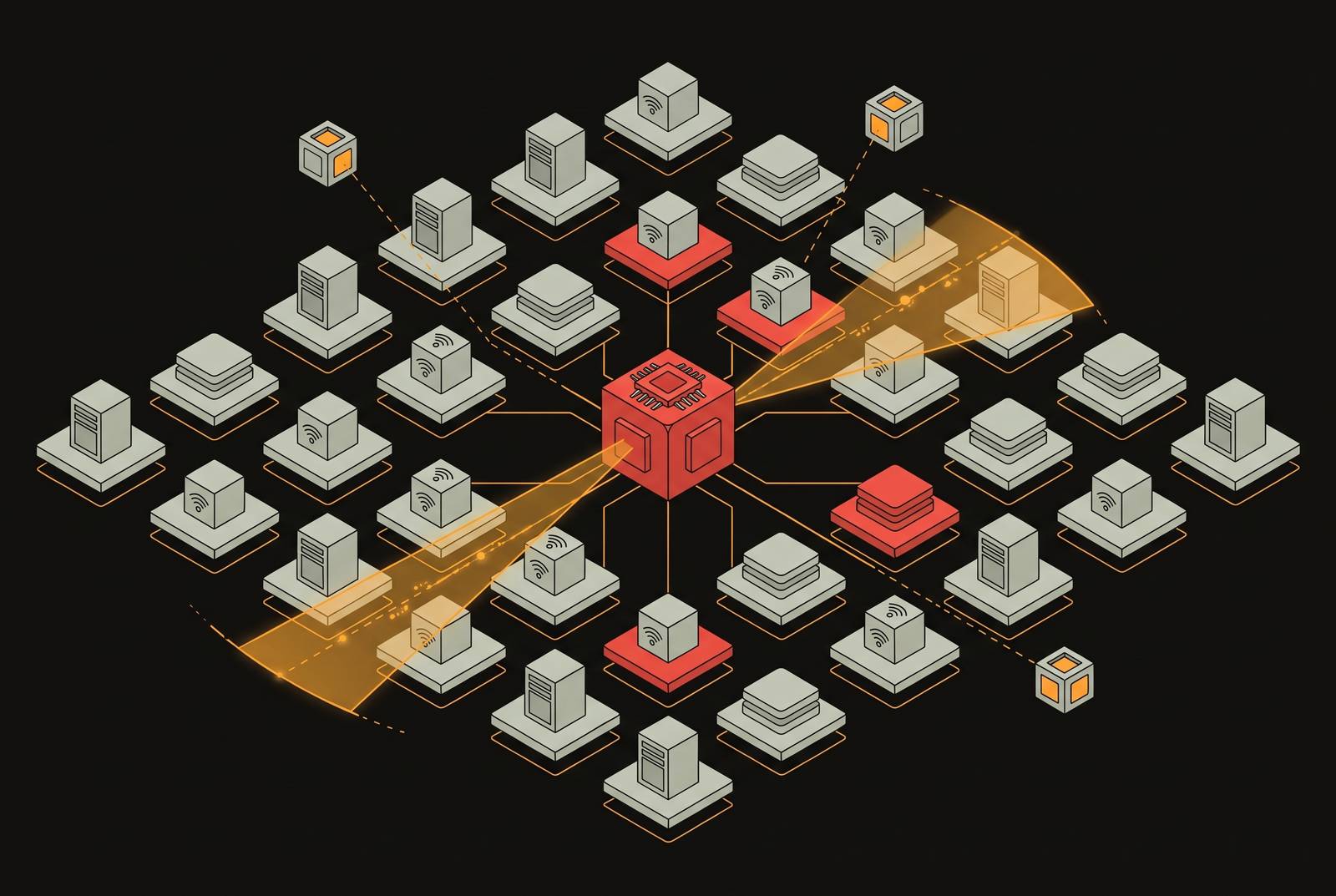
Active discovery then looks for infrastructure that the public material may not name. AI scouts use neural pattern matching on traffic signatures and protocol headers to identify unmanaged cloud assets and IoT devices, sometimes called “silent nodes.” These assets often lack proper controls. Agents can also adjust their approach as they probe, analyzing a rejection signature to infer the firewall or web application firewall type and choose a different approach.
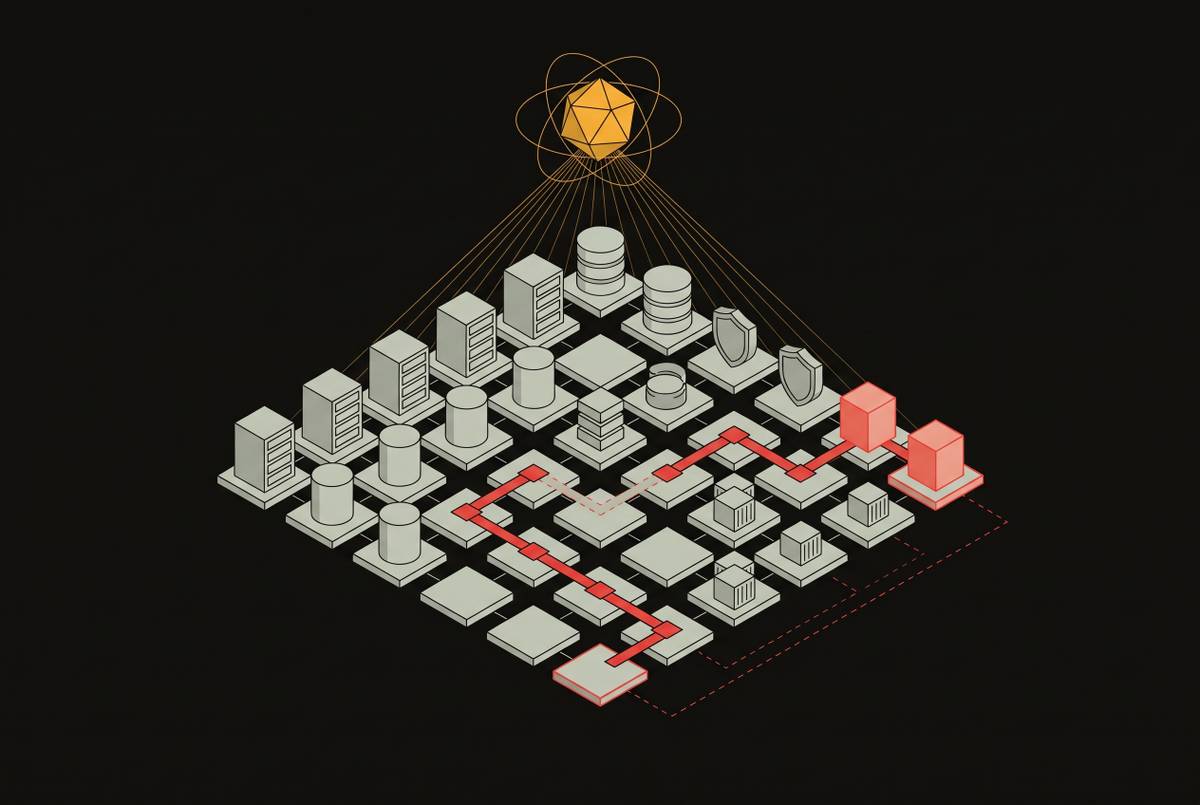
Graph-based prioritization models people, devices, and data streams as connected nodes, then identifies “centrality nodes” whose compromise would offer the greatest reach for lateral movement. The target is useful access. Continuous asset discovery and credential-leak monitoring keep updating that picture, so the pipeline can respond to new infrastructure and exposed credentials.
The structural exposure window that periodic scanning cannot close
An asset can become visible to attackers before it appears in the defender’s inventory. An AI scout that runs all the time can find it within moments of provisioning, while defenders who rely on a quarterly or annual scan may not know it exists for weeks or months. The gap begins at creation. A thorough scan cannot describe infrastructure that did not exist when it ran.
Cloud infrastructure, subsidiaries, shadow IT, SaaS applications, and third-party integrations all expand the internet-facing footprint. Organizations keep underestimating how large that footprint is, while people doing manual discovery struggle to keep up as it grows. This is not a failure of effort. A team can follow its quarterly process to the letter and still use a map that falls behind between assessments.
Shadow IT makes the gap worse because some assets never enter the inventory at all. An unmanaged cloud deployment or unsanctioned SaaS application can remain a permanent blind spot. The phrase “zero-day window of exposure” describes this creation-to-awareness gap, though it is distinct from an undisclosed software vulnerability. The same report found a 42% increase in zero-day vulnerabilities that were exploited before public disclosure in 2026. That puts more pressure on defenders who already struggle to find out what they own before they can check what is vulnerable.
What "fighting automation with automation" actually requires from a security program
The response is to connect discovery, validation, and remediation into a continuous process. Buying an AI tool does not establish that connection. New exposures need to surface as the environment changes, undergo checks that establish whether they are real and exploitable, and reach the people responsible for fixing them. The next annual engagement cannot be the trigger for that work.
Tooling must also keep pace with the attacker’s toolchain rather than depend entirely on a vendor’s update schedule. Fast discovery is only one part of that requirement. Automated exposure validation must pass its results to expert review in the same pipeline, rather than leave three separate tools with outputs that do not connect. Otherwise, automation accelerates collection while the decision about what to fix remains stuck.
Human judgment remains essential to this process. Purely manual security operations cannot keep pace, but fully automated systems produce false positives, miss logic flaws, and cannot credibly sign off on findings for auditors or enterprise customers. An asset that has just been provisioned should move through discovery, validation, and triage without waiting for the next assessment cycle. Even discovering an asset on Monday and triaging it before Friday is not a guarantee of safety. The same report found that the fastest observed lateral movement breakout time in 2026 was just 27 seconds, which shows why every step must take less time.
Why a whitebox pen test is the right unit of validation in this environment
AI-assisted reconnaissance weakens the premise that an external attacker begins with little knowledge. Semantic scraping, public-intelligence correlation, and graph analysis can reveal stack versions, shadow assets, and trust relationships without source-code access. A blackbox test that restricts testers to outside knowledge can spend its limited time reconstructing information a sophisticated adversary already has. The restriction can limit the paths the engagement examines.
Whitebox access gives testers source-code repositories, cloud configurations, and product documentation so they can investigate those paths directly. Threat modeling gives that access a purpose. Who are the realistic adversaries, what do they want, and what would success look like? Goals such as exfiltrating customer PII or escalating to cloud admin turn testing from a search for isolated defects into an examination of how access can spread.
The useful unit of a finding is the “Path to Compromise.” A report should show how weaknesses chain together to reach customer PII, admin credentials, or cloud IAM roles, with a working exploit proving each finding. A CVE list cannot establish that chain. The engagement should also improve detection and response through new SIEM detection rules, better incident response runbooks, and architectural changes that close authority pathways through service accounts, inherited roles, API tokens, and admin groups. Those changes tackle how an attack succeeds as well as which package needs a patch.
How to tell a real pen test from a scanner with a cover page
For a CTO evaluating vendors, quality starts with a question. “What methodology do you follow, and can you share a redacted sample report?” The answer should reveal a repeatable process, specific findings, and exploit evidence. A sample containing only CVEs, CVSS scores, and generic advice such as “update the package” does not demonstrate adversary simulation. Reluctance to share a sample leaves the buyer without the clearest evidence of what the engagement will deliver.
The next questions establish who does the work. Ask for named testers, their certifications, CVE history, and public conference talks, and require disclosure of subcontracting. Then ask where human judgment occurs, which findings receive individual validation, how false positives are handled, and how authorization and business logic flaws are assessed. Someone must own the conclusions. A claim that testing is human-led means little unless the vendor can explain who reviews and signs off on the evidence.
Ask how quickly a critical vulnerability reaches the team, because a critical issue found on day three should not wait two weeks for the final report. Per-IP or per-page pricing is a signal to examine whether the work is scanner-led, since manual testing does not scale linearly per IP. Two quotes for the same scope can buy very different work. The cheaper report may be a scan with a cover page, miss breach-causing flaws, and still fail to satisfy an auditor.
What compliance frameworks actually require from a pen test, and where they fall short as a security ceiling
SOC 2 does not state that a penetration test is required. Auditors widely expect one as a form of evidence for monitoring activities under Trust Services Criteria CC4.1, but vulnerability scans and internal audits are also possible forms of evidence. The compliance driver is legitimate. The framework does not, however, prescribe the test’s methodology, depth, or scope, so an audit requirement alone does not define a strong engagement.
HHS proposed a Security Rule update in January 2025 that would make annual penetration testing an explicit HIPAA requirement. As of the time of writing, it remains a proposal. Healthcare organizations should plan for it without treating it as current law. ISO 27001 also gives organizations sound reasons to pay for testing, but none of these frameworks says how deep validation must go to meet threats from AI-capable adversaries.
The distinction between scanning and testing is important here. A vulnerability scan uses automation to find what might be wrong, while a penetration test is led by humans who try exploitation to prove real-world risk. Auditors increasingly want that proof. Still, a point-in-time annual test can become months stale as assets and attack paths change, even if it served its audit purpose.
Compliance therefore sets a floor for security work. Its value is not diminished by recognizing what it leaves unspecified. A thorough test can help with audit-readiness while proving findings and mapping real attack chains. The choice is between evidence produced mainly to complete an audit and evidence detailed enough to guide engineering work as well.
What defenders and security buyers must now demand to stay even with attacker capability
Buyers should demand a scope that accounts for shadow assets, cloud misconfigurations, third-party integrations, and internal trust relationships. Attackers look into those connections, so testing them should be part of the work alongside the main application. An engagement that leaves them out is sampling. Its proposal should make clear how coverage extends beyond the assets already listed in the inventory.
That coverage must connect to the pace of development. Continuous pull-request-level scanning brings automated security review into every pull request rather than postponing it to a quarterly or annual cycle. It belongs with continuous asset discovery and exposure validation. A code check alone does not establish that the changing deployed environment has been assessed.
Every reported finding should come with an exploit shown to work and sign-off from a human expert. The reviewer should have proven hands-on exploitation skill and should own the conclusion presented to engineering teams or auditors. Fixes need proof too. On-demand retests should be a built-in right, so remediation ends with verification that the patch worked.
Finally, buyers should demand audit-ready outputs from the same engagement, including a letter of attestation and a report format accepted for SOC 2, HIPAA, and ISO 27001. There is no reason to separate the compliance exercise from the work that establishes real risk. The procurement standard should be concrete. The program must show what it discovered, how each reported path worked, who validated it, and whether the fix closed it.