Automated Attack Path Mapping With AI in Cloud Environments
AI continuously maps how attackers could chain cloud vulnerabilities into full account compromise.
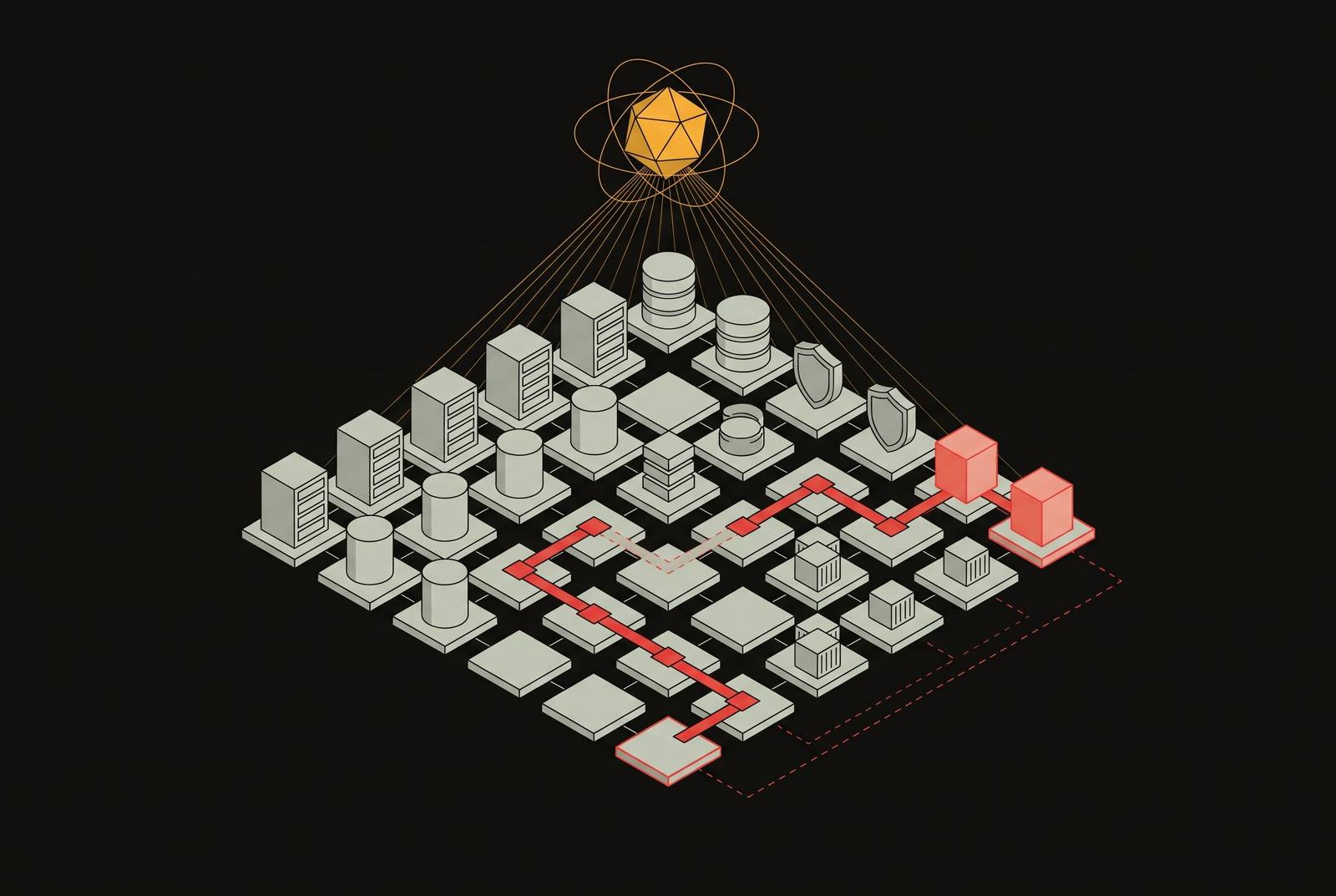
AI-native attack path mapping connects cloud assets, identities, permissions, and weaknesses to show how an attacker could move from exposure to impact. It is a continuously updated picture of connected risk. Genuine coverage depends on what the system can see, how accurately it models those connections, and whether human experts can prove the paths are exploitable.
Why cloud environments broke the assumptions that point-in-time security testing was built on
Cloud control planes, including admin consoles, APIs, and storage endpoints, are internet-facing by design. That makes credentials the main control boundary, rather than the network perimeter that shaped conventional penetration testing. IAM tokens, OAuth grants, API keys, and service account credentials control access to the services that are linked together. The boundary moves when those access relationships change. A test can get those relationships right and still be out of date by the next deployment.
Non-human identities make that change harder to track. Service accounts, bots, workloads, and AI agents frequently outnumber human users, often with excessive permissions and no standardized rotation or retirement process. CSA’s Top Threats to Cloud Computing 2026 identifies these identities as fast-moving lateral paths when their permissions are too broad. A model calling an API through an orchestration layer, accessing a code repository, and sending results to a SaaS tool links several services into one chain. A weakness in one node can therefore expose resources beyond it.
A new deployment can change that chain without changing the application’s public address. For example, a new API route paired with an overprivileged service account creates an access relationship that an earlier assessment could not examine. A test from January cannot show what the environment looks like in July. Periodic testing is structurally limited because its findings belong to a particular version of a system that keeps changing.
How AI has changed the speed and scale of cloud attack path discovery for adversaries
The same CSA report ranks AI-enhanced attacks among the top two threats to cloud computing. It defines them as attacks that use AI to accelerate reconnaissance, find vulnerabilities, develop exploits, and automate activity across many targets at once. Work that once required a multi-week manual exercise can move at machine speed. The underlying attack goals have not needed to change. AI makes the work of finding and connecting weaknesses faster.
Attackers use AI to discover network topology, harvest credentials, analyze permissions, and chain vulnerabilities. They also use it to generate polymorphic malware that evades signature detection. The report identifies cloud identity abuse as the most observed technique against critical infrastructure.
For defenders, the problem is a mismatch in tempo. An attacker can analyze the environment as it exists while the security team works from an assessment completed months earlier. Even a better test once a year cannot keep up with that pace. Defenders need discovery that operates at comparable speed and coverage, so that changes in access and exposure enter the defensive picture while they are still current.
Why identity and permissions — not just exposed ports and unpatched CVEs — are the core of a cloud attack graph
A cloud identity can be dangerous without having an obviously dangerous permission. A principal with limited access may reach full admin through a chain of IAM actions that look defensible when reviewed separately. Actions such as iam:CreatePolicyVersion, iam:AttachRolePolicy, and iam:PassRole, combined with ec2:RunInstances, can form a path to full account control. The combination changes the risk of each permission.
An RCE or insecure deserialization vulnerability in a workload with an overprivileged IAM role can turn application compromise into cloud credential theft. The application flaw lets the attacker in, and the role sets how far they can go. Long-standing IAM misconfigurations become especially dangerous when another weakness supplies a way to use them.
Palo Alto Networks describes linking a four-or-five-step chain across identities, code, data, workloads, and cloud resources as complex and computationally expensive for standard, rule-based tools. Those tools may flag a vulnerable VM and an overly permissive role without connecting them. More alerts do not solve that structural problem. Understanding the route requires a data model that represents relationships.
How AI-native attack path mapping works mechanically — from asset ingestion to exploitable path
Assets, identities, permissions, network flows, configurations, and findings must be normalized into a single data lake before the system can analyze them together. The graph represents these elements as interconnected nodes and calculates the weight and relationship of their links. Each security module adds what it knows about its own domain. The graph then connects that context across boundaries that separate scanners would treat independently.
Permissions require calculation. An IAM policy describes only part of what an identity can do because resource policies, permission boundaries, and service control policies also affect access. Accurate mapping works out effective permissions down to the object level. Without that step, a graph can confuse what a policy allows with what an identity can actually access. Its paths would then rest on an incomplete account of what the attacker could actually reach.
Palo Alto Networks illustrates the difference with a vulnerable VM, an over-permissive IAM role, and a PII-containing S3 bucket. A list presents three findings, while a graph connects them into a route from internet exposure to data exfiltration. Another vendor shows how a misconfigured AI endpoint serves as the starting point of a full attack path that leads to sensitive data. The connected context reveals why its exposure is dangerous.
AI then discovers candidate paths, evaluates their feasibility, and ranks them rather than presenting every theoretical route as equally urgent. Palo Alto Networks says Cortex Cloud keeps finding complex paths and checking their exploitability, using incident response intelligence to shape its detection logic. That analysis also needs a complete inventory. CloudMatos identifies hidden APIs and shadow assets as part of the required scope because a known-inventory scan cannot cover resources missing from its starting list. Continuous ingestion keeps both the inventory and its relationships current.
The specific vulnerability classes that cloud attack paths run through — and why they chain
Server-side request forgery, or SSRF, makes a server issue requests to internal endpoints on an attacker’s behalf. Against a cloud instance using IMDSv1, that access can yield IAM credentials and turn a web application flaw into cloud access. The role attached to the workload determines the next hop. An overprivileged role makes the initial flaw more consequential because the stolen credentials open a wider path. The application and identity risks cannot be judged separately.
Hardcoded secrets offer another way across that boundary. Credentials stored in Lambda functions, ECS task definitions, or EC2 user data can give an attacker initial access, often with more permissions than they needed for their original purpose. Insecure deserialization and RCE can likewise expose cloud credentials when the compromised workload has an overprivileged role. SQL injection and XSS remain relevant as footholds before an IAM pivot. The first weakness need not be cloud-native to start a cloud attack chain.
Once credentials are available, IAM escalation can connect the foothold to a data store or production workload. PMapper models IAM users and roles as a directed graph to find privilege escalation and alternate routes to resources or actions. The graph approach is already established in tooling. AI-native mapping builds on that relationship-based view by combining source code, cloud configuration, and runtime context. Its advantage over separate class-by-class scans is the ability to connect the initial weakness, credential acquisition, escalation, and lateral movement into one candidate path.
Why whitebox access to source code and cloud configuration is what separates complete coverage from a partial picture
External scanning finds exposed ports, storage that is open to the public, and misconfigurations that can be seen at the network boundary. It cannot see a credential embedded in a Lambda function’s environment variables or an IAM role silently attached to a container definition. A detailed external assessment can therefore still provide only a partial picture.
Whitebox access brings source code and cloud configuration into view. Code access exposes hardcoded secrets, insecure defaults, trust-boundary mistakes, and authorization logic flaws before deployment. Access to the configuration shows how resource policies, service control policies, and permission boundaries work together to set effective access. External testing judges exposure and deployment drift, while internal access makes the application’s logic and permission structure available for assessment.
For AI-native mapping, repositories, configurations, and product documentation also support analysis of paths that do not yet exist in production. A pull request introducing an API route with an overprivileged service account can be flagged before the route goes live. Continuous pull-request scanning integrates that work into CI/CD rather than waiting for a post-deployment test or annual audit. Broader access improves what can be modeled, but it does not by itself prove every modeled path works.
Where automated attack path mapping reaches its limits and why human expert review remains necessary
Automation handles continuous ingestion and graph traversal at a scale no human team can match. It can connect thousands of identity-permission relationships, detect known weakness patterns, and rank paths by structural risk. Those strengths make it useful for finding candidates quickly. They do not make every candidate a demonstrated vulnerability. A graph can represent a route that real-world constraints prevent an attacker from traversing.
Exploitability is where evidence has to replace inference. A working exploit proves that a candidate path is usable. Human review is also needed for business logic flaws that depend on understanding how the application is intended to behave. Without that understanding, an automated system cannot reliably distinguish acceptable use from an abuse of the application’s rules.
Why pay for a human to review paths if AI can map them all? Because mapping and proving are different tasks. A report full of theoretical routes creates noise and can offer false confidence when customers or auditors expect evidence. Assessments supporting SOC 2, HIPAA, and ISO 27001 need human-driven adversarial testing, exploitation evidence, chained paths, and business logic findings that automated scanning alone cannot supply. The appropriate model gives automation the coverage and monitoring work, while a certified human expert reviews every finding, validates exploitability with a working proof of concept, and signs the attestation.
What genuine cloud attack surface coverage looks like in practice, and how to evaluate whether you have it
For engineering and security leaders, these mechanics provide practical questions to ask before an assessment begins. Does its access scope include source code, cloud configurations, and identity relationships, or only the network boundary? Can it examine Lambda environment variables and calculate IAM effective permissions? Missing access means missing paths through those relationships. The output should also show how multi-hop routes connect, beyond ranking misconfigurations one at a time.
Evidence and timing deserve the same scrutiny. Is every reported finding backed by a working exploit, and does a named, credentialed expert review and attest to it? Does assessment run on every pull request and infrastructure change, or only at scheduled intervals? These questions test different parts of the method.
Warning signs include identical risk assessments across different clients, no business logic findings, no chained attack path examples, no exploitation evidence, and no retesting after remediation. Each absence leaves a gap in what the report can support. A thorough assessment can provide security evidence and help prepare for an audit at the same time. The practical standard is a current map, broad internal visibility, demonstrated paths, and accountable expert review. That combination is technically achievable today with AI-native tooling and human expertise.